Cowles “Mountain” Hike & Lake Murray Stroll

Cowles Mountain  (1,593-foot summit) is the highest point in the city of San Diego. It’s part of Mission Trails Regional Park, a 5,800-acre open space preserve that is the 7th-largest open space urban park in the United States. It contains sixty miles of hiking, mountain bike and equestrian trails.

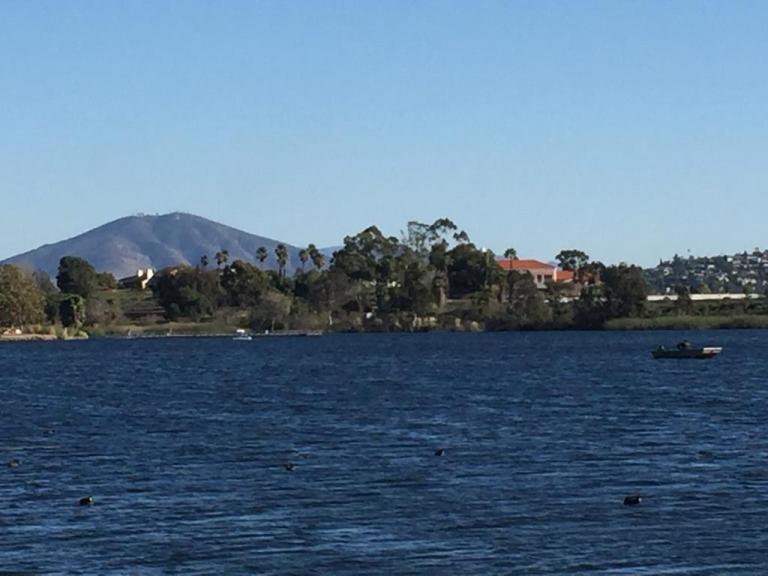
To call Cowles a mountain is to be very liberal with the word. I should note that the park has a 5 “peak” challenge if your hiking peeps want a minor challenge and want to document your feats – here’s the scoop. Cowles is the highest peak. This might be fun for kids, but apparently lots of adults do it for bragging rights too. I will say that on a clear day, the stunning views span 360 degrees from Lake Murray, downtown San Diego, Point Loma, La Jolla, and Mexico and out across the glimmering Pacific to the San Carlos Islands. See feature picture above. (Unfortunately, I dropped my camera on a rock so I have limited pics.)

fireroad route up Cowles

Distance: 2.9  miles up & back

It’s a very popular trail so expect lots of humans and their canines…There are a couple of different ways to reach the top from various starting points and parking lots. The hike itself is moderate (with some steeper sections that will get those calves & glutes burning). It’s decent workout, especially if you run it. There are single track trails and some fire road. It’s short from any direction so I explored up and down on a couple of trails and was a little disappointed that there wasn’t more to see. You can’t really get lost so do as much or as little as you like.

Getting there:

The main trailhead is in the San Carlos neighborhood on the corner of Golfcrest Drive and Navajo Road

Lovely Lake Murray

Since I didn’t quite get enough enough of a workout  / nature fix, I decided to check out alluring Lake Murray  Reservoir, also part of the Mission Trails Regional Park. I strolled the paved road that navigates around most of the lake stopping short of the dam (no access). It’s another popular spot – walkers, runners, bladders, and even road bikers aplenty (the latter seems silly to me, because the path / road is only 3.2 mi long and there are many children and dogs on it).

Lake Murray is a great spot for birdwatchers with abundant ducks, geese, and herons abound and about 149 bird species to observe. It’s a pleasant spot for a picnic too.

Go Fish

Lake Murray is open for shore fishing and private boats, kayaks, and float tubes seven days a week from 5:30 a.m. to 8:00 p.m. Permits can be purchased onsite at the iron ranger boxes. The lake is stocked with Florida-strain largemouth bass, bluegill, channel catfish, black crappie, and trout. Minimum size limit for bass is 12 inches.

Fish limits: 5 trout, 5 bass (min. 12 inches), 5 catfish, 25 crappie and bluegill total,  no other species limits

Lake Murrayjpg

Lake Murray 2
That’s Cowles Mountain in the distance


Kiyomizudera, Kyoto: Magnificent temple and Higashiyama District excursion

Yes, another temple to put on your list of top 10 things to do in Kyoto. Kiyomizudera is a must see historical monument of ancient Kyoto and an UNESCO World Heritage site. (TripAdvisor rates it as the #3 thing to do in Kyoto.)

Founded in 780, Kiyomizudera (Pure Water Temple)  is an independent Buddhist temple and one of the most celebrated temples in Japan. The magnificent Hondo or main hall is built on a cliff on the eastern hills of Kyoto, halfway up Mt. Otowa on the site of a waterfall (hence the name).The temple is dedicated to the diety, Kannon, and continues to be a pilgrimage site. Kannon is depicted with 11 faces and forty arms, and revered for his mercy and compassion. It is said that Kannon is the embodiment of each person’s “invisible heart of gratitude”.

A message from the temple:

Happiness for all via a greater sense of gratitude for your everyday life.

How’s that for a timeless message that we can all strive to achieve?

The buildings and grounds are breathtaking, but the crowds can be overwhelming. I later learned that it opens at 6AM so it might be that the early risers have the place to themselves then. I imagine experiencing a sunrise here would be enchanting.  That being said, night viewing, while extremely crowded, was undeniably magical.  Three times per year in the spring, summer and autumn, the temple buildings are open  at night and lit so artistically – the effect is extremely dramatic and beautiful. Check schedule for night viewing dates

Main Entrance

Nio-mon, the main entrance (above), was burnt down during civil war (1467-1477) and rebuilt in the 16th century.

gatehouse or shrine


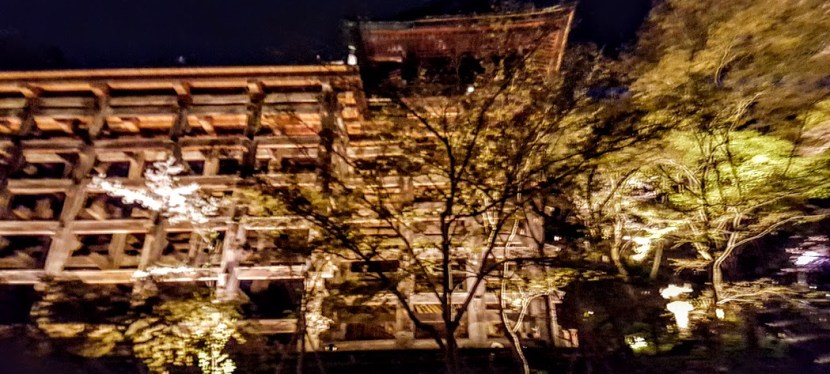
The cliff-side, Hondo was rebuilt in 1633. It features ancient Japanese construction methods and was built entirely without nails (like ancient jenga). It is an impressive architectural wonder. I’m not sure my feature picture captured the massive size and intricacy of the wood construction so here is a picture that does a much better job. Photo Credit: http://www.kiyomizudera.or.jp

Hondo

The views from there to Kyoto city below are quite lovely. (Understatement.)

Dreamy Kyoto Vistas

Note: The main hall is under construction between February 2017 and March 2020 so some viewing areas may be covered, but the building will still be open to visitors.

Hours: Open 6AM, closing  time depends on the season. See schedule. 
Open: 365 days per year
Admission: ~$4

Make a Day or Night of It

If you have time, you’ll want to explore the Higashiyama District itself, it’s one of the city’s best preserved historic districts, just outside the temple grounds. Here you can experience  the charm of old Kyoto. Narrow lanes and traditional architecture transport you back in time. Take it all in as you stroll by quaint shops, cafes and restaurants that have been catering to tourists and temple pilgrims for centuries. Pick up some souvenirs here and stop in for tea, a snack or a meal.

Note: This Higashiyama District closes down early in the evenings, except during light festivals, such as the night viewings at Kiyomizudera so inquire and plan accordingly.

Looking for other cool things to do in Kyoto? Check out Nijo Castle. Ready to get out of the city and into the countryside – maybe take a dip in an onsen (hot springs)? Consider exploring the country hamlets of Kibune and Kurama.


Nijo Castle, Kyoto: A magical, historical site to see, especially at night during the Sakura Festival

Put Nijo Castle on your list of the top 10 things to do and see in Kyoto. (While trip Advisor lists it as #40 of things to do, I’d say the evening viewings during the Sakura (Cherry Blossom) Festival in the spring are well worth the visit.)

Visiting the Kyoto residence of Japan’s first shogun circa the Edo Period, you will be transported to another time and palace. Built in 1603, the castle was completed twenty-three years later by his grandson. The castle and its grounds (including picturesque cherry and plum tree orchards) are surrounded by stone walls and moats.

When the Tokugawa Shogunate fell in 1867, Nijo Castle was used as an imperial palace.  Eventually, it was donated to the city as a historical site and opened to the public.

Designated an UNESCO world heritage site, the castle’s buildings are some of the best surviving examples of the Japan’s feudal era palace architecture.

20160405_190215_001

The 36,000-square-foot Ninomaru Palace consists of five buildings and is built almost entirely of Hinoki cypress, much of which is adorned with gold leaf and elaborate wood carvings.

Interesting fact: The nightingale wood floors of the palace were constructed to squeak as a way of announcing intruders.

During the Sakura Festival in the spring, the castle offers special evening viewings. It mesmerizing to walk under the dozens of cherry trees with their bountiful blossoms dancing in the breeze against the night sky. And the castle, with its moat and fortified walls, is much more impressive glimmering in the moonlight. It’s quite a magical experience.

20160405_191745_00320160405_192252_001

Cherry blossom fantasy land. (Well, minus the omnipresent crowds.)

Hike & Soak in Serenity, Kibune to Kurama, Northeastern Kyoto

I’ve always been captivated by the idea of hiking from village to village – anywhere. When I was researching things to do near Kyoto before my trip, I learned of the short hike from Kibune village to Kurama village and decided it was a must do.

It was so much of a “must do” squeezed into my tight itinerary that I went ahead with my plans despite the downpour that day. Who knows when, if ever, I’ll return to Japan. (I was prepared with rain gear and warm clothes and no doubt the conditions would make the reward of the soaking in the Kurama Onsen even more decadent – it did.) Perhaps the title of this post should be : “Hike, get soaked and then soak.”

It didn’t take me long to explore the quaint, tiny hamlet of Kibune. In the heavy rain, few people were out and all the buildings seemed sealed tight against the elements. The only exception was the Kibune-jinja Shrine on the left hillside near the road.

I believe a wedding was taking place…


Apparently there are some amazing restaurants in Kibune with open dining platforms that extend over the rushing river below. Sadly, not today. After I checked the shrine out, I walked down steps, crossed the street, and walked over the river on the vermilion bridge to the trail head.

After paying the ~$3 entrance fee to the attendant in the little gate house and being warned of treacherous, muddy trail conditions, I cinched up my rain jacket hood and set out. (The attendant did not stop me or tell me that the trail was closed so I figured it would just be a muddy, slippery slog that would make me appreciate the onsen at the end even more – it did.) The hike is a mere 3.9km / 2.4 miles, but the mud and slippery conditions made what would have been a 40 min walk, much longer. It’s single track through the forest with Shinto shrines to discover along the way. You’ll know you’ve reached Kurama when you encounter picturesque Kurama dera, Buddhist temple.

Kurama dera, Buddhist Temple

Unfortunately, I have no pictures on the trail as it was raining so hard, I didn’t dare take my camera out. At the trails end, you have just 1 kilometer to go to reach Kurama Onsen.

At the Onsen, you have the option of soaking in an indoor spa or outdoor pool. I’m sure you can guess which one I chose. (For scoop on Onsen etiquette, see my previous post on the Fukuzumiro Ryokan.)

I soaked in the serene, lush mountain scenery, listening to the pitter patter of the rain drops on the leaves, watching the mist rise from the hot pool as the cool rain kissed my face and shoulders. I was transported to a different time, a different place, a different life. (Calgon eat your heart out.) And no, I don’t have pictures of this incredible setting – no cameras allowed for obvious reasons, but there are a couple of pictures on TripAdvisor

Reluctantly leaving this scene behind, I enjoyed a sumptuous feast at the inn’s restaurant before returning by train to Kyoto.

Delightful Tempura Appetizers

Notes: You can hike the trail in either direction, but Kurama is a preferable end destination because it has more restaurants and is home to the Kurama Ryokan (traditional Japanese Inn) and Onsen (hot spring/ bath house). Apparently, this is the easier direction as well. Highly recommend this as a half day , full day or over-nighter out of Kyoto.

I imagine these villages are even more scenic in the fall with the red maple leaves and in the summer, when everything is green and glimmering.

Festivals:

On October 22, Kurama has a Fire Festival is that involves men and children carrying torches. It is a rite of passage for the town’s youth. I’ve read this is so overrun with tourist now that it’s difficult to see anything due to crowds.

Held in November at various Inari shrines on different days, including Kibune, the Ohitaki rice harvest festival is a thanksgiving event.

Distance: Relatively easy 3.9km / 2.4 miles – not quite as easy when muddy & slippery.

Getting there: It’s just a 30 minute train ride to Kibune via the Eizan Electric Railway from Demachiyanagi Station in northeastern Kyoto (each ~$4 one way).  You can catch the Eizan Electric Railway train back in Kurama.

Top Pick: While I didn’t stay overnight at Kurama Ryokan, I can speak to my Onsen and restaurant experience, both of which were superb.


Short, somewhat steep, semi-sweet: Monserate “Mountain” Hike, Fallbrook, CA

Monserate Mountain is more of a steepish molehill than a mountain. You can hike, bike or run up the trail for a short, steep, incline workout and the reward of expansive views of the mountains (Agua Tibia, Red Mountain, Santa Ana Mountains), farmland in the valley below, and a sliver of Pacific Ocean way out to the west.  I have mixed feeling about this one for reasons detailed below…

History

Monserate Mountain was part of an 13,323-acre Rancho Monserate Mexican Land Grant from 1853 that originally extended south and east of the present day Fallbrook down to the San Luis Rey River.

Pros

If you’re in or near the area, you can get a quick workout here with sweet 360 degree views at the top. Also, I think that it might be the right balance of tough and short for hardy hiker kids who get a feeling of accomplishment from doing something challenging.

There are a couple offshoot trails on the way up: Canoninta Trail and Red Diamond. I didn’t take those, but once at the top, headed south along a Ridge Trail to the water tank. This was the best part of the hike for me – it faced away from the freeway on a little stretch of single track with views into the valleys below and east across the mountain ridges. The Ridge Trail descends gradually with the help of a short wooden staircase and then drops you out on a paved road. (In the pic below,  I turned around and ran up the staircase for the pure joy of a little more incline.)

Glutton for the incline.
Mountains to the east from the Ridge Trail.


Cons
The barren, dirt trail going up has little to no aesthetic appeal. This trail gets lots of traffic, human and dog (too much I’d say). And I’m afraid it smells like it too. (I have a sensitive schnozz and the trail smelt like dog poop most of the way up.) Also read a review that someone got bitten by a dog twice on this trail.  The roar of the 15 freeway below is also a bit off putting as are the weekend crowds that you have to hike around. (I was so uninspired and turned off by the dog poop smell, I didn’t take any pictures on the way up.) Yes, that bad – but then again, I’m a hiking snob. You’ll see why if you visit some of my other posts.
If you’re in the area, do it. Otherwise, I wouldn’t go too far out of your way for this one.
Distance: 3.2 miles up and back without add ons, or 4.4 mile loop adding on the Ridge Trail loop to the water tank.
Elevation gain /loss: ~1150 feet, moderately strenuous, depending on what shape you’re in. If you’re a trail runner, you’ll like it and you’ll want to add on the Ridge Trail water tank loop.
Terrain: Mostly wide dirt path with rocks and some erosion, some single track, paved road & fire road if you do the 4.4 mile loop.