Magnificent Mammoth Lakes’ Duck Lake Trail, John Muir Wilderness

If you like pristine wilderness and glimmering, translucent alpine lakes, you’ll love this hike in the Eastern Sierras near Mammoth Lakes, CA. You’ll be rewarded every couple miles of effort with one of the 6 refreshing gems along the route.  (If you’re into trout fishing, you’ll definitely want to bring your pole. They say the higher you go, the bigger the trout.)


This slideshow requires JavaScript.

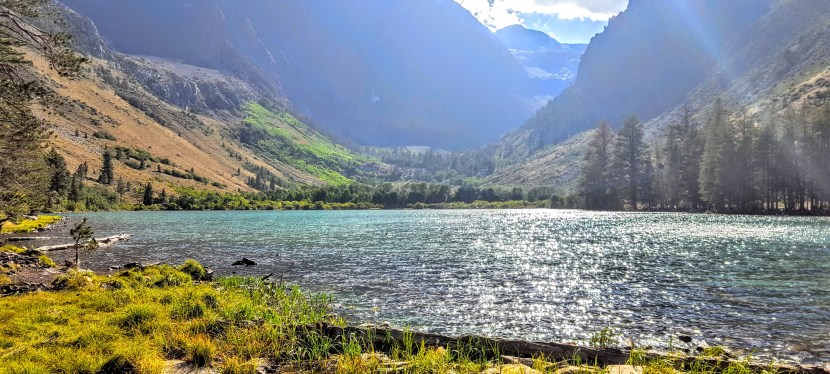
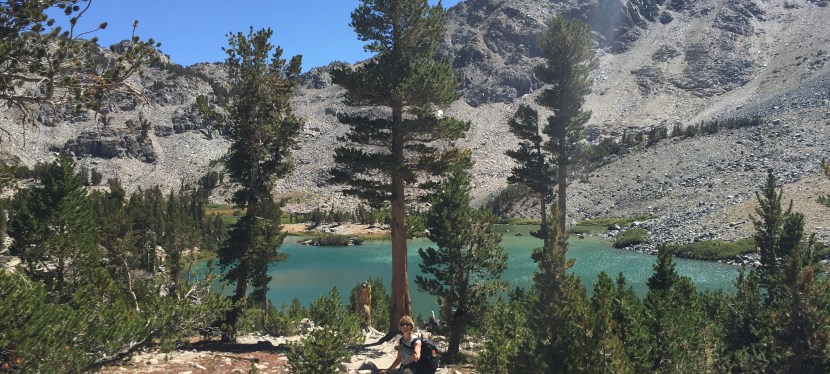
You’ll come upon the first lake, Heart Lake, at mile 1. While you might feel a little silly stopping so soon after embarking, you won’t want to miss this little gem. And given the altitude and incline, you find that you’d like to enjoy the view for a minute or two. Arrowhead Lake is next at mile 1.2 (9,680 ft) followed by Skeleton Lake and Barney Lake (10,022 ft) at 2.5. Once you tear yourself away from Barney, you’ll hit some switchbacks. Spectacular Duck Lake (10,850 ft) will reveal herself to you around mile 4. While you’re there you can visit her adjacent,charming  little sister, Pika Lake. If you continue on, the pines close in on the narrow trail as you continue climbing, descending, climbing  and traversing to Purple Lake (8 miles). (You can camp anywhere along the way as long as you are at least a 100 feet from lakes or streams.) We camped above Purple Lake, which was a bit anti-climatic after Duck Lake. Purple Lake has its own more subtle, woodsy allure, but the outstanding beauty of Duck Lake was mesmerizing and where I found my bliss.

For a quick overnighter, I pack some luxuries. For this trip that included the cozy, warm pants and fuzzy top you see in the picture. I also like to forgo a tent and just enjoy the night sky and wilderness. The gloves and the hat were necessities. It gets cold at night at altitude even when temps have been in the high 70s during the day. Despite my suggestion, my boyfriend did not bring a hat or gloves. He said. “It won’t get that cold.” I should have snapped a pic of him with his mummy back zipped all the way up with only the tip of his red nose sticking out. In the morning as our boots crunched along on the ice slicked trail, he conceded, “I guess it did get cold last night.” (Yes, we’re at altitude in the Eastern Sierra’s so even in late August, it can get quite chilly at night or when a storm front comes through.)

This trail is doable for a day hike, trail run or an overnighter. And it connects to the Pacific Crest Trail so there’s ample opportunity to just keep going.  Kind of wish I could have, but I’ll be back.


Scenery: AWESOME

Difficulty: Somewhat strenuous given the altitude and fairly continuous climb

Access:  Via Coldwater  Campground 

Starting  elevation: 8,900 feet

Permit required. Pick it up with your bear canister (if you’re over-nighting with food) at the local Forest Ranger Station.

Dry Creek Falls hike, Cascade Locks, OR

Another trail misnomer as Dry Creek Falls are quite wet indeed and a quick, convenient and refreshing excursion.

The trailhead is near the Bridge of the Gods in Cascade Locks, a city in Hood River County, Oregon. Cross the road and head for the signed Pacific Crest Winter Trailhead. When you reach Moody Street (~.1 mi), go under the freeway and veer right then straight onto the gravel road and left at the trail junction. (A bit anticlimatic to start, but you’ll be disappearing into the trees before long.) The PCT Dry Creek on a wooden bridge. Instead of crossing that bridge take a right and head up toward the falls, which is only .2 miles away. Head back on the trail the same way you came.

Take a leisurely stroll on the friendly trail or get your blood pumping with a quick, out and back trail run. Enjoy the woods, ferns and streams along the way. (Fall colors and wildflowers depending on the season.) If you work up a sweat, look forward to dousing yourself in the 75-foot waterfall that cascades over the colossal wall of columnar basalt. You may want to bring water shoes, the bottom is rocky and difficult to navigate in bare feet.

Below the falls you’ll notice remnants of an old water control structure that once provided water for the city. Dry Creek remains a municipal water source here. If you’re up for something longer, you can also explore the PCT where it crosses Dry Creek on that wooden bridge and then just head back  the same way you came.


This slideshow requires JavaScript.

Distance round trip : 4.4 miles

Difficulty: Easy

Rating: Nice!

Back in the saddle: Celebrating the New Year on the trails @ Calavera Nature Preserve, N.County SD

If I can’t be on the loose in the wild somewhere, I usually commemorate New Year’s Day by giving myself at least a half day of vigorous nature time. (It could be trail running, surfing, hiking, biking, rollerblading, swimming, or any combination.) With “base camp” in Southern California, it usually means I get a crisp, bright, sun-shiny day in which to play. This year, I had some physical downtime that interfered so my celebration was delayed until yesterday. It was one of those splendid, crystal clear, high- resolution,  after the rain kind of days that puts a smile on your face. The air smells so fresh and sweet, you can’t get enough. Precisely what I needed after 17 days of relative inactivity and indoor imprisonment.

20161211_155815

It’s amazing how good it is to move freely outdoors after any amount of downtime – no matter the length or reason. This is what I am most grateful for and what I live for – the simple, primal pleasure of my body in motion out in nature.

While my body is still telling me to “take it easy”, I wanted to get my heart rate up just a bit so I pulled my mountain bike out for a short spin on the trails in the Calavera Nature Preserve. (And yes, I am spoiled to have this little gem in my backyard.) Not by accident mind you – it was one of the top 3 reasons I chose to live in this area.) Granted, the trails here can be a bit gritty, and there’s some rocky, rutted single-track and even nasty wide-track stuff that I can’t make on a mt. bike. Nevertheless, it’s a slice of nature in N.County , San Diego, a small habitat for many critters (49 bird, 10 mammal and 7 amphibian/reptile species) and a haven to two-legged critters like me who need a quick nature fix close to home.

A little about Calavera Hills.

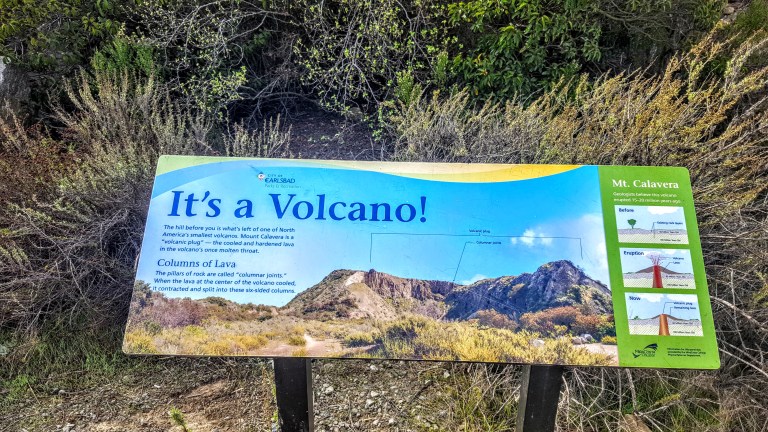
it's a volcano.jpg
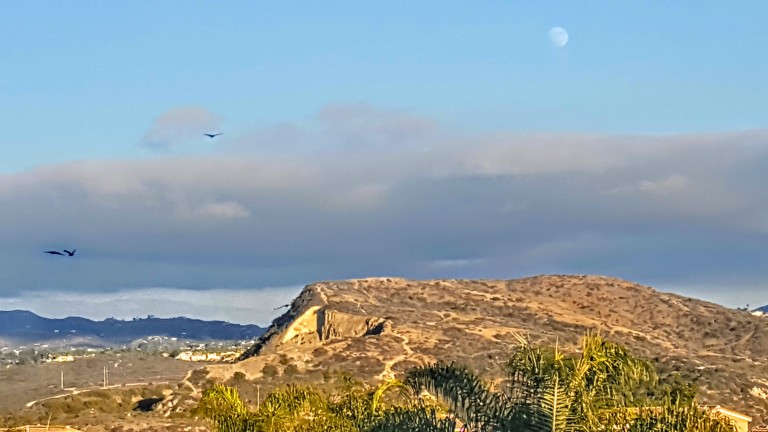
The word calavera, skull in Spanish, speaks to the preserve’s centerpiece, the ~500 ft mount, the remnant of a 22 million-year-old volcano.

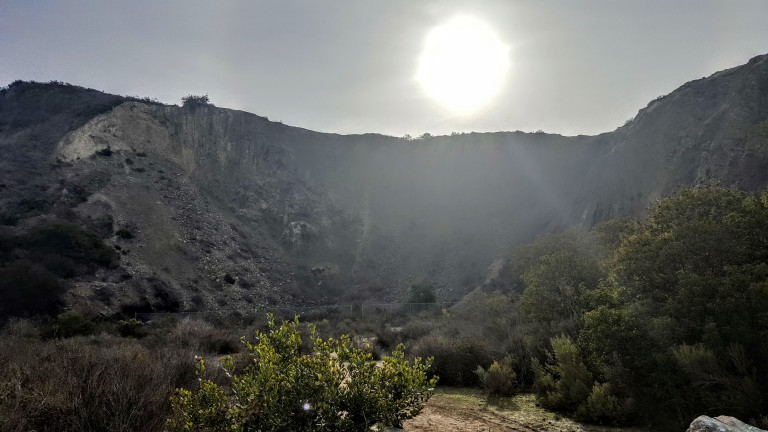
the-volcano

According to some sources, this is one of only three volcanic plugs in Southern California. From the early 1900’s until ~1930, the area was mined for gravel, leaving a pocked and scarred West face.

Don’t expect well-marked trails, but you can easily navigate by the 3 landmarks – the lake, the top of the Mount, and the Water Tank with the new high school below it.

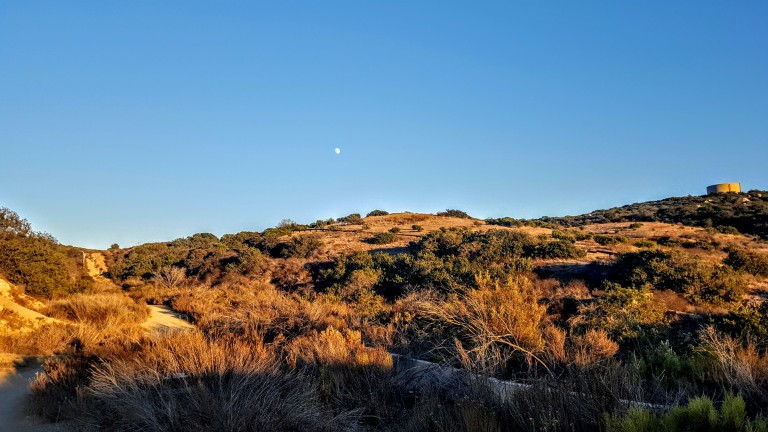
ch-water-tower
Water tank top right. (The “Mount” is to the left.)

If you’re hiking, biking, or running and want a good workout with some great views, go for both “heights”. If you’re a masochist for hills, there’s a brutal fire road that runs around the back rim. It’s punctuated by a half dozen or so steep rocky downs that flip in a matter of feet to fierce climbs. Guaranteed to get your heart rate up, up and over your comfort zone. Otherwise, there’s plenty of trails you can link together for some mileage that are flat or just a little rolly with a mix of easy to slightly technical. There’s fun discoveries for kids, including a cave,  the lake itself, cairns, a stone labyrinth, a funky memorial, (so much for leave no trace), a hidden wooden bridge, and more.

This slideshow requires JavaScript.

How did you commemorate the New Year?


Ramona, CA: Cedar Creek Falls Trail

My expectations for the Cedar Creek Falls Trail were low as I’d read about crowds and litter here. Hiking in the off-season has it’s perks – no crowds and no litter – yay!  (The trade off, just the damp shadow on the rock tracing where the 80 foot water fall flows.)   Otherwise, I was very pleasantly surprised. The terrain is perfect for trail running if you can handle a consistent ~ 2 mile descent, followed, of course, by the consistent ascent. My knees can’t take the downhill anymore, but I sure enjoyed the run back up.

This slideshow requires JavaScript.

In the summer the temps can climb to 115 degrees so heat stroke and dehydration are concerns. Not the place to take your pooch or that friend who hasn’t worked out in recent memory  – there have been several deaths. Also, people have been seriously injured for  jumping off the rock into the shallow pool (duh). Those who live in this area of Eastern San Diego are accustomed to the hum of helicopters flying in to pick up the pieces. There were some cross country high-school boys risking it while I was there. Showing off for their girlfriends. Boys will be boys and survival of the smartest applies here.

Distance: 6 Miles Round Trip for this out & back

Rating: Moderate to easy if you are in shape, difficult otherwise

Permit needed.

Washington’s Beacon Rock Trail: a shortie with sweet views

Geological origins

According to some experts, Beacon Rock or  Che-Che-op-tin, which means the navel of the world, is the second largest, free-standing monolith in North America.  (Supposedly approaching the ranks of El Capitan, Devils Tower, Uluru/Ayers Rock, and other notables.) Composed of Basalt, it is the core of an ancient volcano. Through the ages, massive floods carved their way through the Columbia River Gorge and through the volcano, leaving only the core of Beacon Rock in their wake.

The trail

The Beacon Rock Trail was built directly onto the side of the rock, and ascends to the top of the rock (850’ elevation) by way of 52 switchbacks. Along the way there are sparkling panoramic views of the Columbia River Gorge, the Bonneville Dam, and the Pierce Wildlife Refuge. The “peak” area is small and doesn’t offer much in the way of scenery. It’s a short and relatively easy ~1.6 mile out and back with a 680 foot elevation gain. There’s  a fair amount of traffic as it’s right off Highway 14, perfect for a quick run up and down. (Of course, I happened to hit it at high noon on Washington’s hottest day in a record-breaking heat wave. Dangerous for pets or anyone not up to extreme temps.)

The story behind the trail

The story goes that the United States Army Corps was going to cannibalize the rock for material to build a jetty at the mouth of the Columbia River. In 1915, philanthropist, Henry Biddle, bought the rock for $1, and together with Charles Johnson, built the trail over the next 3 years. After Biddle’s death, the family offered to make it a state park. Washington initially declined, but accepted the offer after Oregon expressed interest.


Details

Located near Stevenson, WA off of Highway 14

Discover Pass must be purchased and displayed in your car.