Stunning Stonewall Peak Hike, Cuyamaca Rancho State Park, San Diego

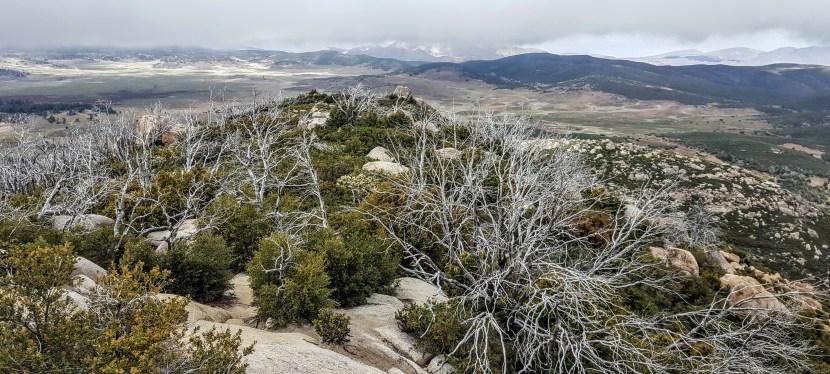
Cuyamaca Peak‘s little sister, Stonewall Peak, (5,730 feet) outshines her big sister with her stunning granite crown, haunting tree skeletons (remnants of the Cedar Fire) and lovely vistas of Cuyamaca State Park and out to Anza  Borrego. Before I moved to North County and started exploring the area, I had no idea that all this wonderful natural beauty is an easy drive from greater San Diego.

20180526_123510
Gradual ascent on a friendly trail

20180526_123853

20180526_123918
Expansive views
20180526_1327051
Interesting rock formations along the way
20180526_131650
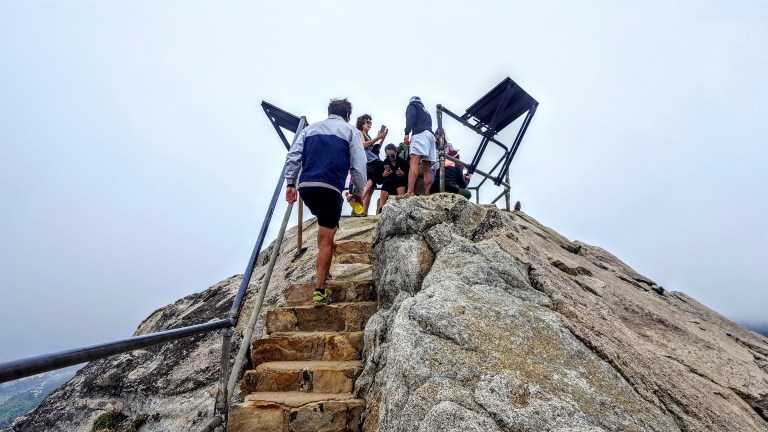
Stairway to heavenly vistas


20180526_132305
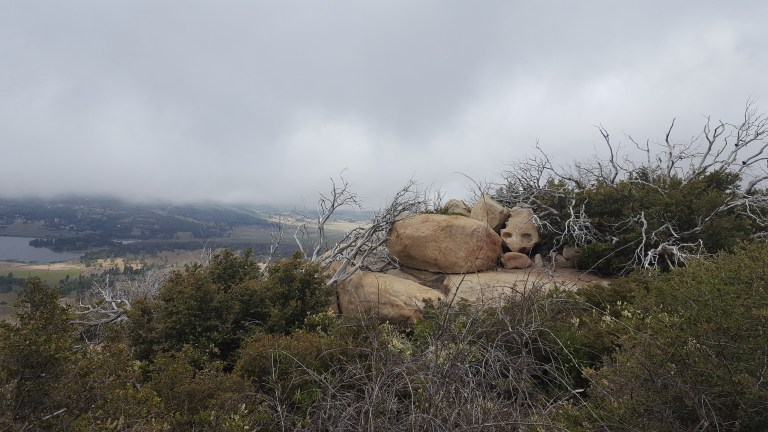
Something about these beautiful trees and boulders
20180526_131807
A bit crowded at the actual peak – silly people looking down at their phones
20180526_133310
Lovely Lake Cuyamaca views on the way down
20180526_141756
A sprinkling of dazzling wildflowers

20180526_140149

Planning your Cuyamaca adventure

You can make it a day or a weekend adventure and do as much or as little hiking as you like. Ambitious, fit hikers can take on both peaks (Cuyamaca & Stonewall)  in a day. For the less ambitious, there are plenty of opportunities to add on easy short strolls by the lake and up to Stonewall Mine. Lots of wildlife viewing with trails for the whole family. Stay tuned for my next post. Happy trails!

The historic gold mining town of Julian is a mile or two away with its quaint shops, B&Bs, restaurants and famous pies.

Notes: This is the most popular hike in the park so go early to avoid the crowds. After you reach the Stonewall Peak spur trail and make a right, there’s a really short scramble over some rocks before you hit the last rocky stairway.  Keep your eyes open for the metal handrails.  On the way back, I recommend taking a right at the junction for a different route down ton what becomes a pleasant single track trail d. At about 3.7 miles, you come to a trail intersection. Make the left onto Vern Whitaker Trail. Shortly after that (around 3.9 miles) there’s another junction, continue to stay left. At 4.2 miles or so,you’ll encounter another side trail; stay your course to the left again.

Miles: ~<4 miles rt if you just go up and down the main trail.  My scenic route adds about a mile & a half for ~5.5 miles rt.

Elevation gain: 1,050 feet

Terrain: Mostly sweet, clear terrain (as in trail runnable). It’s gets a bit rocky and pesky for a while near the top so watch your footing. .The single track down was mostly friendly.

Difficulty: Easy to moderate. Depends on your fitness level and the route you take.

Trailhead: Across the street from the Paso Picacho campground, Cuyamaca State Park

Parking: $10 State Park Fee

Dogs: Only allowed on paved roads and must be leashed.

Camping: Paso Picacho campground has family campsites with tables, firepits, running water and bathrooms.

On the loose, hiking Cuyamaca Peak, San Diego County, CA

It’s relatively easy to “bag” the second highest peak in San Diego County as it tops out at just 6,515 feet. You’ve got a choice between two routes or a combo of them. I opted for the scenic trails up and took the paved  road down to make a loop. Views were good on both routes, but far more solace, solitude and wildflowers on the less traveled, natural trail.

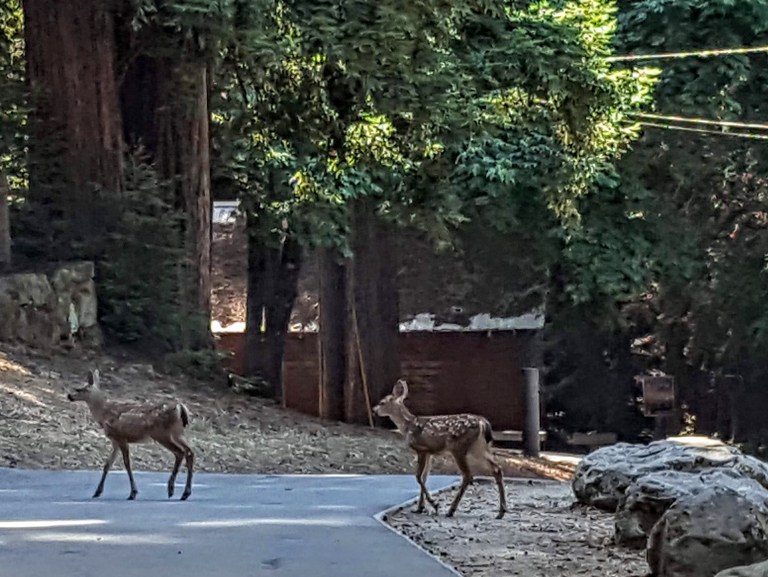
In 2003, the Cedar Fire , California’s biggest  wildfire (started by a lost hunter who lit a signal fire that burned out of control) decimated 290, 278 acres, including 90% of the Park’s 24,700 acres. The ravages from that fire are still rampant, but these formerly rich forest (oaks, willows, adlers, and sycamore tress, cedar, white fir, ponderosa, Coulter, sugar and Jeffrey pine) and meadowlands are slowly making a comeback.  More than 100 bird species abound in the park, including acorn woodpeckers, northern flickers and red tailed hawks, Mammals you might encounter here include gray fox, badger, bobcat, mountain lion and deer.

Azalea Glen Loop
Azelea Glen Loop Trail

sign If you reach this sign, refill you water at the spring, but you want to turn back and follow the fireroad about a 1/4 mile to the Coneja Trail connector and take that on up to the peak.
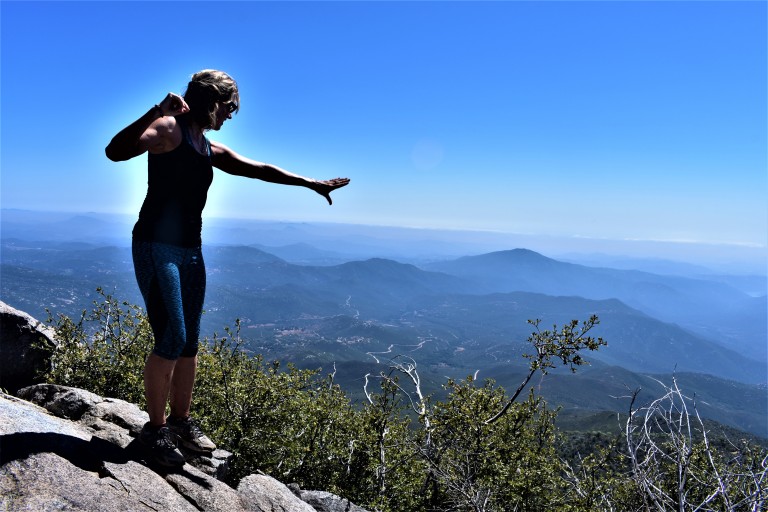
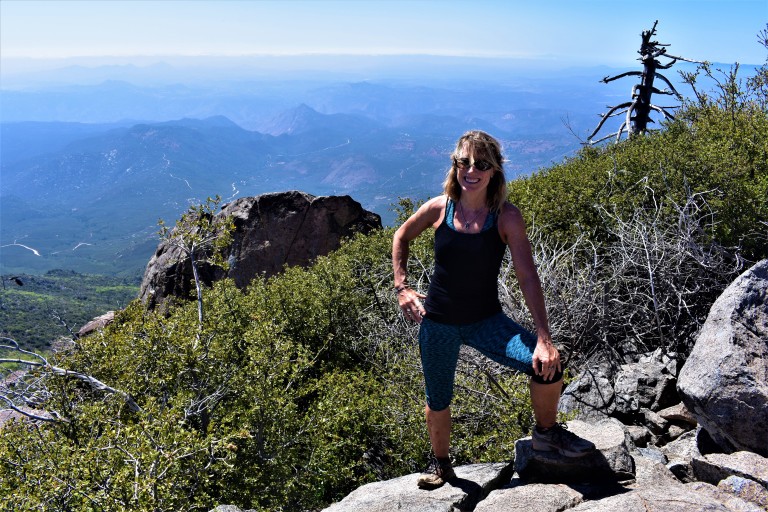
 

At the top

Unfortunately, it wasn’t a clear day so the Salton Sea and Anza-Borrego Desert to the east and Pacific coastline to the west and all the mountain vistas surrounding were a bit difficult to discern.

photo directing

DSC_0876

Is it just me or does the burnt tree in the picture above evoke an Indian chief bowing his head?  (Kumeyaay Indians occupied the Cuyamaca mountains from antiquity until around 1857.)

DSC_0885.JPG

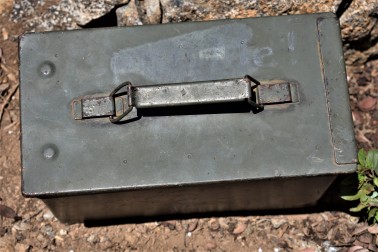
You can document your peak bagging effort by opening this box and signing in.

sign in box

vestiges fire and view
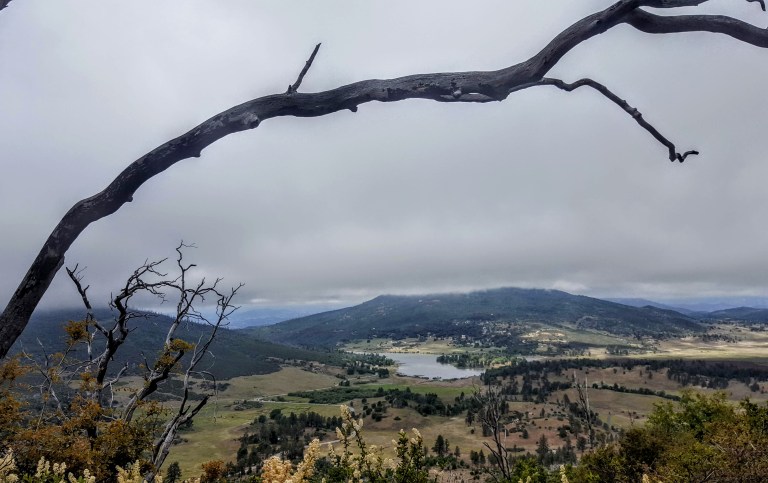
Views to Lake Cuyamaca and the Valley below
stonewall peak
A framed view of Stonewall Peak
Stonewall peak closer up
A closer view of Stonewall Peak

There are plenty of other trails to explore nearby including a switchback trail up and down alluring Stonewall Peak (4 miles rt) and hidden waterfalls somewhere…(I’ll let ya know when I find them.) If I’d had more time I would have done Stonewall too. (The trail head is right across the campground entrance.) There’s more than a 100 miles of trails for hiking, horseback riding and a select number for mountain biking here. I’ll be back.

Planning your excursion

You can make a day or a weekend of your Cuyamaca adventure. The historic gold mining town of Julian is a mile or two away with its quaint shops, B&Bs, restaurants and famous pies.

Notes

Miles: 7.7 miles rt (Or just 5 miles rt if you take the paved road both ways.)

Elevation:  1700 ft gain/ loss

My route: Azelea Glen Loop to Azalea Glen Road. Make a right on the Azalea Fire Road, a left on the single track Conejo Trail that comes up in a 1/4 mile. The Conejo Trail hooks up with Lookout Fire Road about a 1/2 mile from the top – the steepest portion.)

Terrain: Mostly sweet, soft terrain (as in trail runnable), until you get to the Conejo Trail. It’s gets a bit rocky and pesky for a while on there so watch your footing. (Another reason I chose the paved road downhill.)

Difficulty: Moderate. Depends on your fitness level and the route you take. The 1/2 mile incline at the top is tough, but it’s all quite reasonable. I brought hiking poles but did not bring take them on the trail and was fine. (I have bad knees.) It would be a bit relentless to take the paved road up. (I wouldn’t mind trying it on a mtb bike. Heard about some people who did on road bikes – that’s a little nutty. Took me 2 hours up and 40 minutes down – no running…

Trailheads: Both the paved Lookout Fire Road & the Azelea Glen Loop begin at the Paso Picacho campground, Cuyamaca State Park

Parking: $10 State Park Fee

Dogs: Only allowed on paved roads and must be leashed.

Camping: Paso Picacho campground has family campsites with tables, firepits, running water and bathrooms.


Photo Post: Hiking in the hills of Kyoto

Kyoto is surrounded by mountains on three sides so the opportunities to hike abound. I haven’t been able to locate my trail notes on this one so I’m just going to post some photos from my Kyoto walkabout for now.

20160409_123055_003

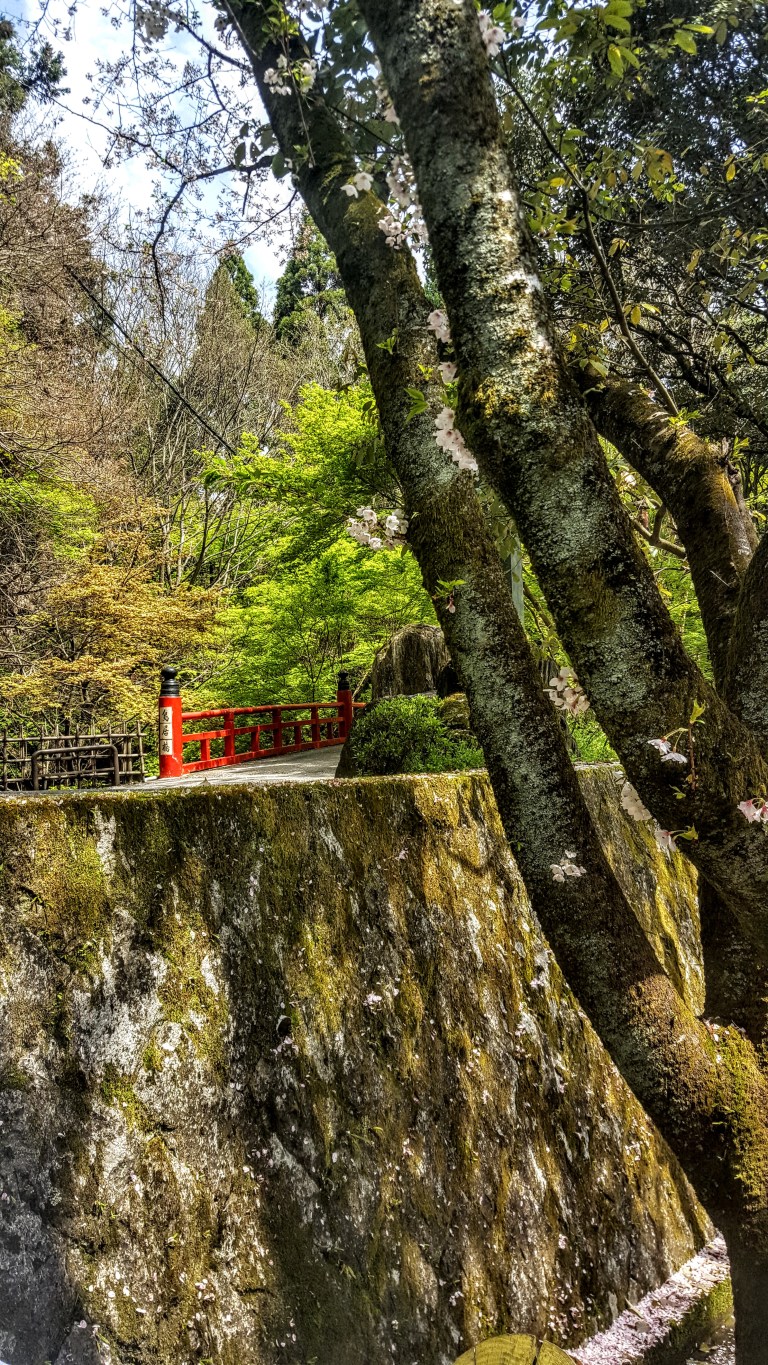
Sometimes your future

is clear and inviting. The

bridge appears; you cross.

20160409_135310_003
Hmm…

Sometimes it’s hard to

know which way to go so let

the forest guide you.

20160409_134906_003
Magical dappled light – must be the enlightened path

Find yourself in the

dazzling, dappled light-your path

to enlightenment.

20160409_133907
Hidden shrines

20160409_140506

20160409_142441
Traditional buildings and cherry blossoms
20160409_144103
Temples

20160409_122313

20160409_144317
Never too far from civilization
20160409_125722
Some signs are more helpful than others…
20160409_125550_001
Trail markers like this one at key intersections between Kyoto suburbia & Kyoto Forest trails were very helpful.

Check out my Kibune to Kurama hiking adventure too (trail notes included in that one).

Cowles “Mountain” Hike & Lake Murray Stroll

Cowles Mountain  (1,593-foot summit) is the highest point in the city of San Diego. It’s part of Mission Trails Regional Park, a 5,800-acre open space preserve that is the 7th-largest open space urban park in the United States. It contains sixty miles of hiking, mountain bike and equestrian trails.

To call Cowles a mountain is to be very liberal with the word. I should note that the park has a 5 “peak” challenge if your hiking peeps want a minor challenge and want to document your feats – here’s the scoop. Cowles is the highest peak. This might be fun for kids, but apparently lots of adults do it for bragging rights too. I will say that on a clear day, the stunning views span 360 degrees from Lake Murray, downtown San Diego, Point Loma, La Jolla, and Mexico and out across the glimmering Pacific to the San Carlos Islands. See feature picture above. (Unfortunately, I dropped my camera on a rock so I have limited pics.)

fireroad route up Cowles

Distance: 2.9  miles up & back

It’s a very popular trail so expect lots of humans and their canines…There are a couple of different ways to reach the top from various starting points and parking lots. The hike itself is moderate (with some steeper sections that will get those calves & glutes burning). It’s decent workout, especially if you run it. There are single track trails and some fire road. It’s short from any direction so I explored up and down on a couple of trails and was a little disappointed that there wasn’t more to see. You can’t really get lost so do as much or as little as you like.

Getting there:

The main trailhead is in the San Carlos neighborhood on the corner of Golfcrest Drive and Navajo Road

Lovely Lake Murray

Since I didn’t quite get enough enough of a workout  / nature fix, I decided to check out alluring Lake Murray  Reservoir, also part of the Mission Trails Regional Park. I strolled the paved road that navigates around most of the lake stopping short of the dam (no access). It’s another popular spot – walkers, runners, bladders, and even road bikers aplenty (the latter seems silly to me, because the path / road is only 3.2 mi long and there are many children and dogs on it).

Lake Murray is a great spot for birdwatchers with abundant ducks, geese, and herons abound and about 149 bird species to observe. It’s a pleasant spot for a picnic too.

Go Fish

Lake Murray is open for shore fishing and private boats, kayaks, and float tubes seven days a week from 5:30 a.m. to 8:00 p.m. Permits can be purchased onsite at the iron ranger boxes. The lake is stocked with Florida-strain largemouth bass, bluegill, channel catfish, black crappie, and trout. Minimum size limit for bass is 12 inches.

Fish limits: 5 trout, 5 bass (min. 12 inches), 5 catfish, 25 crappie and bluegill total,  no other species limits

Lake Murrayjpg

Lake Murray 2
That’s Cowles Mountain in the distance


Hike & Soak in Serenity, Kibune to Kurama, Northeastern Kyoto

I’ve always been captivated by the idea of hiking from village to village – anywhere. When I was researching things to do near Kyoto before my trip, I learned of the short hike from Kibune village to Kurama village and decided it was a must do.

It was so much of a “must do” squeezed into my tight itinerary that I went ahead with my plans despite the downpour that day. Who knows when, if ever, I’ll return to Japan. (I was prepared with rain gear and warm clothes and no doubt the conditions would make the reward of the soaking in the Kurama Onsen even more decadent – it did.) Perhaps the title of this post should be : “Hike, get soaked and then soak.”

It didn’t take me long to explore the quaint, tiny hamlet of Kibune. In the heavy rain, few people were out and all the buildings seemed sealed tight against the elements. The only exception was the Kibune-jinja Shrine on the left hillside near the road.

I believe a wedding was taking place…


Apparently there are some amazing restaurants in Kibune with open dining platforms that extend over the rushing river below. Sadly, not today. After I checked the shrine out, I walked down steps, crossed the street, and walked over the river on the vermilion bridge to the trail head.

After paying the ~$3 entrance fee to the attendant in the little gate house and being warned of treacherous, muddy trail conditions, I cinched up my rain jacket hood and set out. (The attendant did not stop me or tell me that the trail was closed so I figured it would just be a muddy, slippery slog that would make me appreciate the onsen at the end even more – it did.) The hike is a mere 3.9km / 2.4 miles, but the mud and slippery conditions made what would have been a 40 min walk, much longer. It’s single track through the forest with Shinto shrines to discover along the way. You’ll know you’ve reached Kurama when you encounter picturesque Kurama dera, Buddhist temple.

Kurama dera, Buddhist Temple

Unfortunately, I have no pictures on the trail as it was raining so hard, I didn’t dare take my camera out. At the trails end, you have just 1 kilometer to go to reach Kurama Onsen.

At the Onsen, you have the option of soaking in an indoor spa or outdoor pool. I’m sure you can guess which one I chose. (For scoop on Onsen etiquette, see my previous post on the Fukuzumiro Ryokan.)

I soaked in the serene, lush mountain scenery, listening to the pitter patter of the rain drops on the leaves, watching the mist rise from the hot pool as the cool rain kissed my face and shoulders. I was transported to a different time, a different place, a different life. (Calgon eat your heart out.) And no, I don’t have pictures of this incredible setting – no cameras allowed for obvious reasons, but there are a couple of pictures on TripAdvisor

Reluctantly leaving this scene behind, I enjoyed a sumptuous feast at the inn’s restaurant before returning by train to Kyoto.

Delightful Tempura Appetizers

Notes: You can hike the trail in either direction, but Kurama is a preferable end destination because it has more restaurants and is home to the Kurama Ryokan (traditional Japanese Inn) and Onsen (hot spring/ bath house). Apparently, this is the easier direction as well. Highly recommend this as a half day , full day or over-nighter out of Kyoto.

I imagine these villages are even more scenic in the fall with the red maple leaves and in the summer, when everything is green and glimmering.

Festivals:

On October 22, Kurama has a Fire Festival is that involves men and children carrying torches. It is a rite of passage for the town’s youth. I’ve read this is so overrun with tourist now that it’s difficult to see anything due to crowds.

Held in November at various Inari shrines on different days, including Kibune, the Ohitaki rice harvest festival is a thanksgiving event.

Distance: Relatively easy 3.9km / 2.4 miles – not quite as easy when muddy & slippery.

Getting there: It’s just a 30 minute train ride to Kibune via the Eizan Electric Railway from Demachiyanagi Station in northeastern Kyoto (each ~$4 one way).  You can catch the Eizan Electric Railway train back in Kurama.

Top Pick: While I didn’t stay overnight at Kurama Ryokan, I can speak to my Onsen and restaurant experience, both of which were superb.