Exploring the Goat Canyon Trestle by Mountain Bike, Jacumba, CA

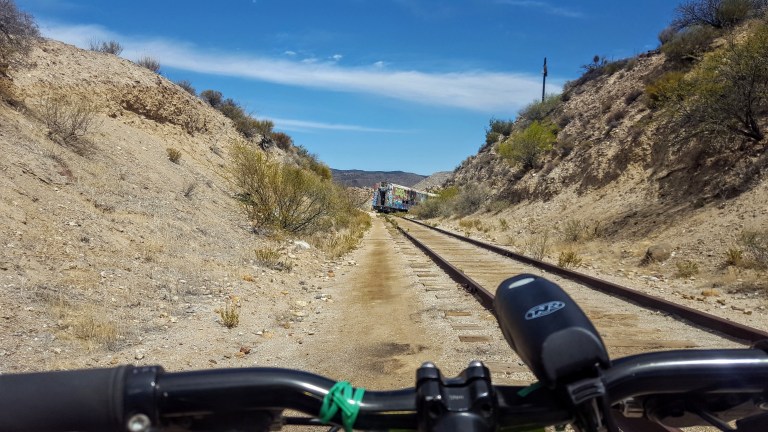
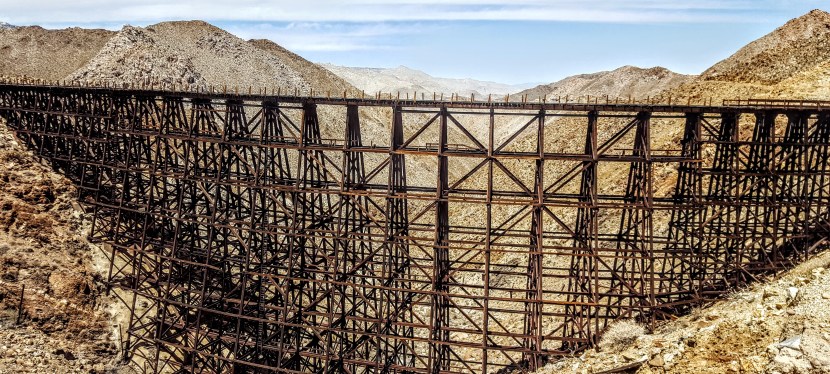
Deep in the heart of the Jacumba Mountains overlooking Carrizo Gorge in Anza Borrego State Park, you’ll find the Goat Canyon Trestle. Getting to the world’s largest curved wooden trestle is like being transported to the wild west of days done by. You’ll traverse dark tunnels in various stages of collapse, dodge rock slides, narrowly avoid precipitous drops into rock canyons, explore abandoned trains and endure the blazing desert sun. If this is your idea of fun, read on. Ok, it’s not that bad. In fact, it’s an easy, flat mtb cruise or a longish flat hike through some very cool (pun intended) desert terrain.

(Video credit and pics I’m in below: Ken Wells)

It’s slow going as there are several points where you have to lift your bike over one obstacle or another. You can’t speed through because you never know what’s around the next corner or if the bottom might drop out in front of you.

20180421_122141.jpg


Be alert and cautious all the way out and back. Headlamps are a must for the tunnels, lots of obstacles in there. Workout-wise, it’s easy – safety-wise, it could be considered a bit sketchy.

20180421_113342.jpg

20180421_130252.jpg

As you bike along the railway, sometimes the path is quite narrow with a precipitous drop into the rocky canyon below. A moment of distraction could make for a very bad day. Wouldn’t suggest mountain biking for kids here, unless they are quite skilled and cautious riders.

20180421_112723.jpg

20180421_112437.jpg

20180421_105723.jpg

Up close, the trestle seems a bit rickety, like a skinny, dilapidated Jenga set.


This slideshow requires JavaScript.


Background: The trestle was built in 1933, as part of the San Diego and Arizona Eastern Railway, aka “the impossible railroad” that ran through Baja California and Eastern San Diego County and ended in Imperial Valley. Over the years, collapsed tunnels and rock slides plagued the railroad, including the collapse of Tunnel 15, which led to the creation of the trestle. The trestle was constructed of wood (no nails used), rather than metal due to the area’s extreme temperature fluctuations, which can lead to “metal fatigue” / failure and it was designed with a 14 degree angle to offset Goat Canyon’s high winds. By 2008, rail traffic had ceased.  As recently as last year, another tunnel, Number 6, near the trestle collapsed…(Yikes.)

Distance: Roundtrip 10 -14 miles, depending on where you start

Getting there: 8E from San Diego, take the Jacumba Exit

Parking: Park for free in the dirt lot right off the freeway at the Jacumba exit and follow the dirt portion of Carrizo Gorge Road 2 miles towards the DeAnza Spring Resort, the largest “clothing optional” resort in North America. Optionally, pay $5 to park at the resort.  1951 Carrizo Gorge Rd.  There’s a Subway & gas station right off the freeway. You can also grab a bite & beer at the resort after your ride…20180421_102928.jpg

Note: This is the desert, plan accordingly – ample water, sunscreen, hat, etc…
 

Kiyomizudera, Kyoto: Magnificent temple and Higashiyama District excursion

Yes, another temple to put on your list of top 10 things to do in Kyoto. Kiyomizudera is a must see historical monument of ancient Kyoto and an UNESCO World Heritage site. (TripAdvisor rates it as the #3 thing to do in Kyoto.)

Founded in 780, Kiyomizudera (Pure Water Temple)  is an independent Buddhist temple and one of the most celebrated temples in Japan. The magnificent Hondo or main hall is built on a cliff on the eastern hills of Kyoto, halfway up Mt. Otowa on the site of a waterfall (hence the name).The temple is dedicated to the diety, Kannon, and continues to be a pilgrimage site. Kannon is depicted with 11 faces and forty arms, and revered for his mercy and compassion. It is said that Kannon is the embodiment of each person’s “invisible heart of gratitude”.

A message from the temple:

Happiness for all via a greater sense of gratitude for your everyday life.

How’s that for a timeless message that we can all strive to achieve?

The buildings and grounds are breathtaking, but the crowds can be overwhelming. I later learned that it opens at 6AM so it might be that the early risers have the place to themselves then. I imagine experiencing a sunrise here would be enchanting.  That being said, night viewing, while extremely crowded, was undeniably magical.  Three times per year in the spring, summer and autumn, the temple buildings are open  at night and lit so artistically – the effect is extremely dramatic and beautiful. Check schedule for night viewing dates

Main Entrance

Nio-mon, the main entrance (above), was burnt down during civil war (1467-1477) and rebuilt in the 16th century.

gatehouse or shrine


The cliff-side, Hondo was rebuilt in 1633. It features ancient Japanese construction methods and was built entirely without nails (like ancient jenga). It is an impressive architectural wonder. I’m not sure my feature picture captured the massive size and intricacy of the wood construction so here is a picture that does a much better job. Photo Credit: http://www.kiyomizudera.or.jp

Hondo

The views from there to Kyoto city below are quite lovely. (Understatement.)

Dreamy Kyoto Vistas

Note: The main hall is under construction between February 2017 and March 2020 so some viewing areas may be covered, but the building will still be open to visitors.

Hours: Open 6AM, closing  time depends on the season. See schedule. 
Open: 365 days per year
Admission: ~$4

Make a Day or Night of It

If you have time, you’ll want to explore the Higashiyama District itself, it’s one of the city’s best preserved historic districts, just outside the temple grounds. Here you can experience  the charm of old Kyoto. Narrow lanes and traditional architecture transport you back in time. Take it all in as you stroll by quaint shops, cafes and restaurants that have been catering to tourists and temple pilgrims for centuries. Pick up some souvenirs here and stop in for tea, a snack or a meal.

Note: This Higashiyama District closes down early in the evenings, except during light festivals, such as the night viewings at Kiyomizudera so inquire and plan accordingly.

Looking for other cool things to do in Kyoto? Check out Nijo Castle. Ready to get out of the city and into the countryside – maybe take a dip in an onsen (hot springs)? Consider exploring the country hamlets of Kibune and Kurama.


Nijo Castle, Kyoto: A magical, historical site to see, especially at night during the Sakura Festival

Put Nijo Castle on your list of the top 10 things to do and see in Kyoto. (While trip Advisor lists it as #40 of things to do, I’d say the evening viewings during the Sakura (Cherry Blossom) Festival in the spring are well worth the visit.)

Visiting the Kyoto residence of Japan’s first shogun circa the Edo Period, you will be transported to another time and palace. Built in 1603, the castle was completed twenty-three years later by his grandson. The castle and its grounds (including picturesque cherry and plum tree orchards) are surrounded by stone walls and moats.

When the Tokugawa Shogunate fell in 1867, Nijo Castle was used as an imperial palace.  Eventually, it was donated to the city as a historical site and opened to the public.

Designated an UNESCO world heritage site, the castle’s buildings are some of the best surviving examples of the Japan’s feudal era palace architecture.

20160405_190215_001

The 36,000-square-foot Ninomaru Palace consists of five buildings and is built almost entirely of Hinoki cypress, much of which is adorned with gold leaf and elaborate wood carvings.

Interesting fact: The nightingale wood floors of the palace were constructed to squeak as a way of announcing intruders.

During the Sakura Festival in the spring, the castle offers special evening viewings. It mesmerizing to walk under the dozens of cherry trees with their bountiful blossoms dancing in the breeze against the night sky. And the castle, with its moat and fortified walls, is much more impressive glimmering in the moonlight. It’s quite a magical experience.

20160405_191745_00320160405_192252_001

Cherry blossom fantasy land. (Well, minus the omnipresent crowds.)

Exploring Fushimi Inari & Its Iconic 10,000 Gates, Kyoto

Another attraction to put on your top 10 things to do in Kyoto list. The Fushimi Inari Shinto Shrine in Kyoto dates back to the seventh century (~711 AD) when the Hata family built it and dedicated it to Inari, the god of rice and sake. Today, it remains the head shrine for over 30 000 Inari shrines across Japan and is one of Japan’s most visited shrines and a top sight-seeing destination. (TripAdvisor rates it as the #1 thing to do in Kyoto – not sure I agree. I was far more impressed with their #3 Kiyomizudera temple, but I was fortunate to experience a special night viewing there.)

The Fushimi Inari Shrine may look vaguely familiar to you if you’ve seen the movie Memoir of a Geisha, some of which was filmed here. But the shrine itself is not the main attraction―it’s the iconic orange torii gates (10,000 and counting) that crown the 2.5 mile pathway up Mount Inari (764 feet). While it’s a relatively short “hike” on a concrete path that winds its way up the hill past multitudes of mini-shrines, it can take a while given the crowds. The “summit” is a bit anti-climatic, city and mountain views were smudged with smog when I was there.

Fushimi Inari
At the entrance…

Instead of returning the way you came, you can hike down the other side of the mount on forest trails into either Yamashina or Tofukuji, another temple area that’s especially popular when the leaves are turning. Really, you can’t go wrong walking anywhere in Kyoto. Kyoto is all about having a scenic, cultural and beautiful experience, but it is Japan so you’ll most likely be sharing that experience with the masses.

Torii gates
Not artsy, just editing out the crowd.

What’s with the gates?

Torii gates symbolize the division between the physical world and the spiritual world. The oldest Torri gates here date back to the 8th century, but new gates are still being added, “donated” by Japanese businesses in hopes of obtaining prosperity and good luck. Today, the price for good luck if you go with a big gate is around 10k; 4k for smaller gates.

What’s with the foxes?

You’ll also encounter many stone statues of foxes, messengers of the god Inari. The foxes often carry symbolic objects, such as a key to the granary (as in the fox in the picture with me at the entrance), a sheaf of rice or a scroll. You may see some fox statues wearing red scarves, which are thought to expel demons and illness. Some fox statues may be equipped multiple tails to symbolize older, wiser and more powerful foxes.

Hours: Open 24/7, best times – early morning or evenings, otherwise expect a crowd.

Cost: FREE!

Getting there:  The shrine is located just outside JR Inari Station, two stops South from Kyoto Station (main station) along the JR Nara Line and takes 5 minutes one way. It is also a short walk from Fushimi Inari Station along the Keihan Main Line.

Notes: There’s a street market and shops and restaurants near the shrine’s entrance and also there are a couple of  little food shops near the “top”.

20160409_100226
Eel on a stick, anyone?

Plenty more sights to see in Kyoto

Ready to check out an ancient shogun’s castle or a wooden temple dating back to 780 that’s built without nails, or would you prefer to get away from it all in the scenic hamlets of Kibune and Kurama?

Forboding beauty of Hell’s Half Acre, Idaho

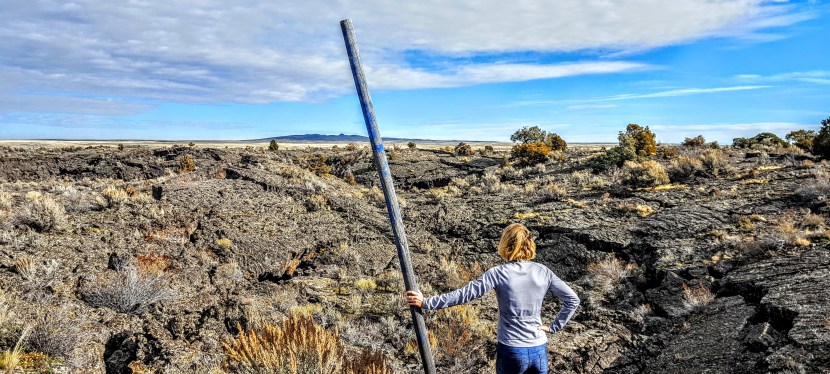
A designated national natural landmark and wilderness study area, Hell’s Half Acre Lava Field is a basaltic lava plain found in the desert ecosystem of the Snake River Plain of Idaho.  It consists of about 150 sq miles of other-wordly terrain created by a lava flow from about 4,100 years ago. There’s a 1/2 mile trail marked by blue poles, you can follow those to the red poles that lead you out 4.5 miles to the central vent, where the lava broke through the surface thousands of years ago  (9.4 mile round trip).

Hiking across a lava field is not for everyone, especially not for the tender footed. It’s cool, but the novelty wears off fast. While the trail is flat and easy, the terrain itself is tough and unforgiving. Lava rock is extremely sharp – like glass shards- and fragmented and the field is a trap of open cracks, gaping holes, jagged rocks and uneven, tortuous footing. It’s slow and treacherous going. One misstep can land your foot or your body in a hole. And if you trip, you’re likely to be broken, bruised or bleeding. Sneakers are not enough, the lava will eat them up. I’d recommend sturdy hiking shoes even for the short stroll. Also, it’s easy to get lost in the vast monotonous beauty of the lava field, you really have to look for those trail pole markers. Not a hike to set the kids loose on. Do not attempt the long hike in the summer as this place gets hot as hades.

20161106_114303.jpg

20161106_114057.jpg

Normally, I’m up for a hiking challenge, but I was happy to keep it short here, especially when I heard the rednecks firing shotguns close by…(sigh).