Exploring Fushimi Inari & Its Iconic 10,000 Gates, Kyoto

Another attraction to put on your top 10 things to do in Kyoto list. The Fushimi Inari Shinto Shrine in Kyoto dates back to the seventh century (~711 AD) when the Hata family built it and dedicated it to Inari, the god of rice and sake. Today, it remains the head shrine for over 30 000 Inari shrines across Japan and is one of Japan’s most visited shrines and a top sight-seeing destination. (TripAdvisor rates it as the #1 thing to do in Kyoto – not sure I agree. I was far more impressed with their #3 Kiyomizudera temple, but I was fortunate to experience a special night viewing there.)

The Fushimi Inari Shrine may look vaguely familiar to you if you’ve seen the movie Memoir of a Geisha, some of which was filmed here. But the shrine itself is not the main attraction―it’s the iconic orange torii gates (10,000 and counting) that crown the 2.5 mile pathway up Mount Inari (764 feet). While it’s a relatively short “hike” on a concrete path that winds its way up the hill past multitudes of mini-shrines, it can take a while given the crowds. The “summit” is a bit anti-climatic, city and mountain views were smudged with smog when I was there.

Fushimi Inari
At the entrance…

Instead of returning the way you came, you can hike down the other side of the mount on forest trails into either Yamashina or Tofukuji, another temple area that’s especially popular when the leaves are turning. Really, you can’t go wrong walking anywhere in Kyoto. Kyoto is all about having a scenic, cultural and beautiful experience, but it is Japan so you’ll most likely be sharing that experience with the masses.

Torii gates
Not artsy, just editing out the crowd.

What’s with the gates?

Torii gates symbolize the division between the physical world and the spiritual world. The oldest Torri gates here date back to the 8th century, but new gates are still being added, “donated” by Japanese businesses in hopes of obtaining prosperity and good luck. Today, the price for good luck if you go with a big gate is around 10k; 4k for smaller gates.

What’s with the foxes?

You’ll also encounter many stone statues of foxes, messengers of the god Inari. The foxes often carry symbolic objects, such as a key to the granary (as in the fox in the picture with me at the entrance), a sheaf of rice or a scroll. You may see some fox statues wearing red scarves, which are thought to expel demons and illness. Some fox statues may be equipped multiple tails to symbolize older, wiser and more powerful foxes.

Hours: Open 24/7, best times – early morning or evenings, otherwise expect a crowd.

Cost: FREE!

Getting there:  The shrine is located just outside JR Inari Station, two stops South from Kyoto Station (main station) along the JR Nara Line and takes 5 minutes one way. It is also a short walk from Fushimi Inari Station along the Keihan Main Line.

Notes: There’s a street market and shops and restaurants near the shrine’s entrance and also there are a couple of  little food shops near the “top”.

20160409_100226
Eel on a stick, anyone?

Plenty more sights to see in Kyoto

Ready to check out an ancient shogun’s castle or a wooden temple dating back to 780 that’s built without nails, or would you prefer to get away from it all in the scenic hamlets of Kibune and Kurama?
Forboding beauty of Hell’s Half Acre, Idaho

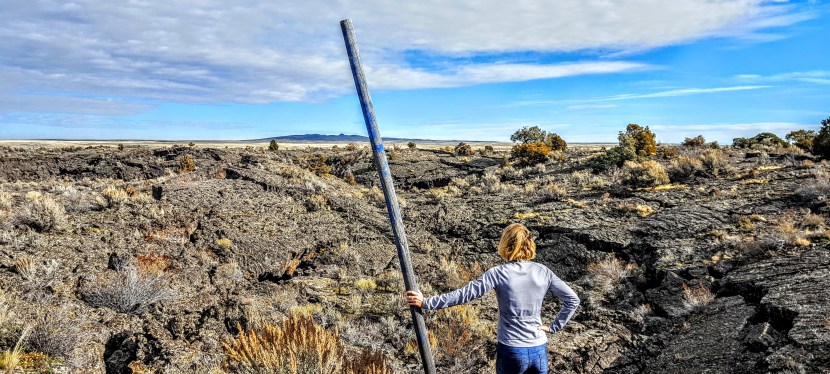
A designated national natural landmark and wilderness study area, Hell’s Half Acre Lava Field is a basaltic lava plain found in the desert ecosystem of the Snake River Plain of Idaho.  It consists of about 150 sq miles of other-wordly terrain created by a lava flow from about 4,100 years ago. There’s a 1/2 mile trail marked by blue poles, you can follow those to the red poles that lead you out 4.5 miles to the central vent, where the lava broke through the surface thousands of years ago  (9.4 mile round trip).

Hiking across a lava field is not for everyone, especially not for the tender footed. It’s cool, but the novelty wears off fast. While the trail is flat and easy, the terrain itself is tough and unforgiving. Lava rock is extremely sharp – like glass shards- and fragmented and the field is a trap of open cracks, gaping holes, jagged rocks and uneven, tortuous footing. It’s slow and treacherous going. One misstep can land your foot or your body in a hole. And if you trip, you’re likely to be broken, bruised or bleeding. Sneakers are not enough, the lava will eat them up. I’d recommend sturdy hiking shoes even for the short stroll. Also, it’s easy to get lost in the vast monotonous beauty of the lava field, you really have to look for those trail pole markers. Not a hike to set the kids loose on. Do not attempt the long hike in the summer as this place gets hot as hades.

20161106_114303.jpg

20161106_114057.jpg

Normally, I’m up for a hiking challenge, but I was happy to keep it short here, especially when I heard the rednecks firing shotguns close by…(sigh).

Palomar Mountain Field Trip: Fun for everyone – hike, fish, astronerd or simply enjoy epic views.

Headed to Palomar Mountain with hiking in mind and got much more out of the excursion than expected.

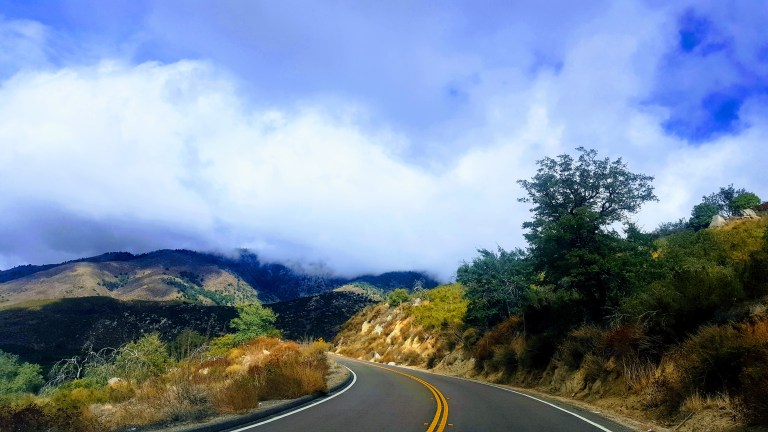
The drive up the South Grade (S6) mountain road is winding and scenic. You’ll want to keep your eyes on the road if you’re driving. Apparently this road has been compared to the L’Alpe d’Huez on the Tour de France Route so it’s popular with road cyclists, motorcyclists and sports car drivers too… Beware of those dare devil motocyclists crossing the center line as they race down the mountain

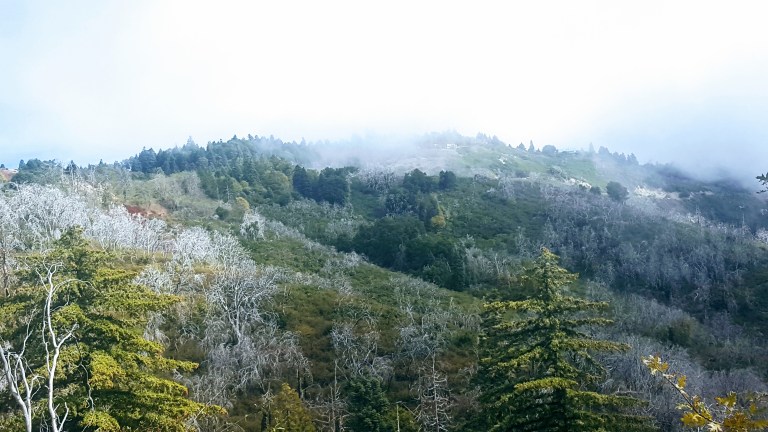
The clouds and fog made for some dramatic vistas on the way up.

20171105_115032.jpg

20171105_120546.jpg

The small park headquarters has a mini natural history exhibit. I didn’t know we had gray fox around here. Signs were up about a recent mountain lion sighting in the park.

20171105_121928.jpg

Hiking Scoop

As far as the hiking here goes, most trails are short and dogs aren’t allowed on them. We did the longest loop we could find, starting at the Doane Pond, which is open for fishing year round and stocked with trout. It’s a  great spot for a picnic too.

Overall, the terrain is easy on the feet – mostly dirt, not too many rocks or roots. It’s ideal for a quick trail run. (Note the seasonal tick and rattle snake warnings.)

We went up the Thunder Springs and the Silver Crest Trails and down Scott’s Cabin Trail and Chimney Flats. (Spoiler alert  – the trails name is a misnomer as there is no standing cabin, just a placard at the site with no historic details on it or in the park’s brochure). The hike is interrupted by the road a couple times and the road is always within a stones throw. The good news – you won’t get lost. The bad news, if you’re a hiking snob like me, it’s a bit anticlimactic, but that’s ok – the views along the ridge, at the Boucher Hill Fire Tower, and by the Observatory are quite epic. And the road and the drive by locations make it accessible for all.

Here’s a video clip of a particularly lovely section of trail.


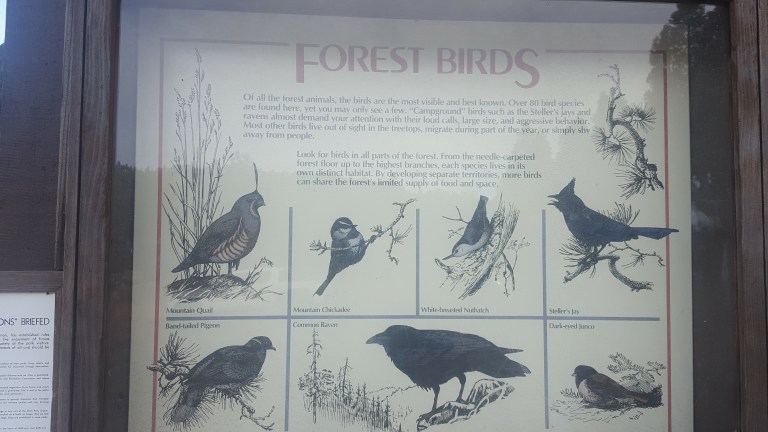
Tree lovers will delight in the variety that this section of the Cleveland National Forest yields:  Douglass fir, white fir, incense cedar, live oak, black oak, coulter pine and yellow pine. Approximately 40 inches of annual rainfall keeps them thriving. Of course all these trees make it a haven for birds and bird lovers as well.

20171105_145101.jpg
We saw all but the quail today.

Camping Scoop

The Doane valley Campground has 31 campsites, each outfitted  with a table, fire ring, BBQ and food locker. Nearby restrooms have flush toilets and coin-operated hot showers. Many comforts of home in a forest setting – great for an introduction to camping. The Cedar Grove Campground has 3 areas for group camping.  For more info and to reserve a spot up to 7 months in advance call 1-800-444-7275.

Enjoy Epic Views from the Boucher Hill Historic Fire Tower

The Boucher Hill Historic Fire Tower is definitely worth a stop too – whether you drive by or hike the 1.2 miles up from the visitor center. This is one of only 2 fire towers left  in California. From the observation deck, you don’t even have to use the provided binocular gizmo to see the glimmering Pacific ~50 miles away.


This slideshow requires JavaScript.

Even with my bad eyes, I could make out Tamarack Tower / Smoke Stack that marks my home beach. You have to know what to look for to make it out in the video, but you can definitely tell that you’re looking out to sea.


Visit the Impressive Palomar Observatory & Museum

And no, the field trip’s not over yet. Next, we headed over to the Palomar Observatory.  The structure itself is quite impressive (see feature photo), but it’s definitely worth looking inside. (Hours are 9-4 daily.) The Hale Telescope is considered one of most important scientific innovations of the last century and was the most productive and prominent telescope in the world from 1948 to 1993.


This slideshow requires JavaScript.

Don’t miss the Museum either. It’s got great displays, info and videos. The small gift shop was closed as we got there late, but I’m sure there’s some cool stuff and souvenirs for the kids in there too.


If you aren’t an astronomy or science buff going in, you might be when you leave. ..

So many fun things to do, see and learn here. Highly recommend Palomar Mountain as a field trip for the whole family. Great way to spend a Sunday afternoon.

20171105_161907.jpg

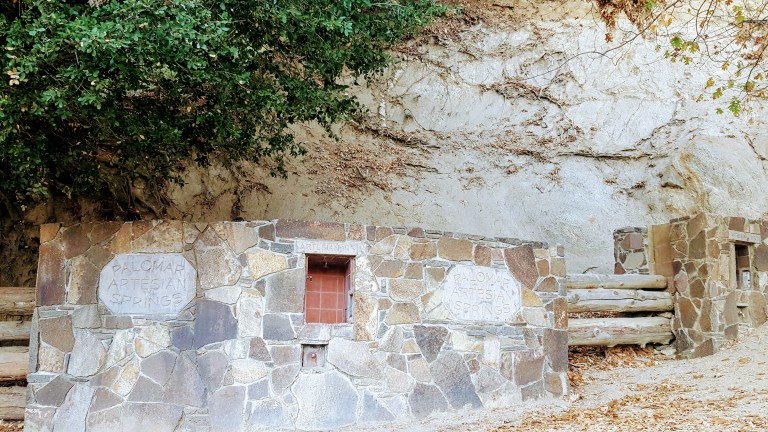
Almost forgot to mention, be sure to bring a water bottle and get your fill of refreshing fresh (and free) spring water on the way up or down at the Palomar Artesian Springs.

20171105_162327.jpg

Cheers and happy trails!


Top Pick: Hakone Open Air Museum – art and nature in beautiful harmony

The town of Hakone is part of the Fuji-Hakone-Izu National Park, less than 60 miles from Tokyo and one of the most popular destinations for Japanese and international tourists. Famous for its natural beauty, many hotsprings (onsen), traditional inns (ryokan), and the view of Mount Fuji across Lake Ashinoko (didn’t get to see that), Hakone is also renowned for its open air museum.

The Hakone Open Air Museum (Hakone Chōkoku No Mori Bijutsukan), is one of the most spectacular outdoor museums in the world. Surrounded by mountains and overlooking a valley, ~100 diverse sculptures (modern and contemporary, including works of Rodin, Milo and Moore) from around the world grace the expansive (~17 acres), rolling gardens. There’s also several indoor exhibits as well, including One of the world’s best collections of Picasso’s work, the 2 story Picasso Exhibition Hall displays a total of 300 pieces, including paintings, sculptures and ceramics. The exhibit also features photos chronicling of the artist’s life is one of world’s best collections.


20160411_124703

In addition there are shops, café’s, multiple kids spaces with art installations that they can climb on and a mini garden maze. And because the Japanese think of everything, there’s even an 65 foot heated foot bath to refresh your weary feet while enjoying the view.

You can easily spend hours here taking in all the beauty and the art.

Take the Hakone Tozan train there – it’s an incredible experience in itself!

The Hakone Open Air Museum is just a few steps from Chokoku No Mori Station on the Hakone Tozan (30 minutes, $3.55 from Hakone-Yumoto). It’s the last station before the terminal station of Gora. Taking the train is an experience in itself as it chugs slowly ,  traversing switchbacks up and backwards as it climbs the steepest slope of all railways in Japan through green forests above the splendidly scenic Haya-kawa River Valley.


This slideshow requires JavaScript.

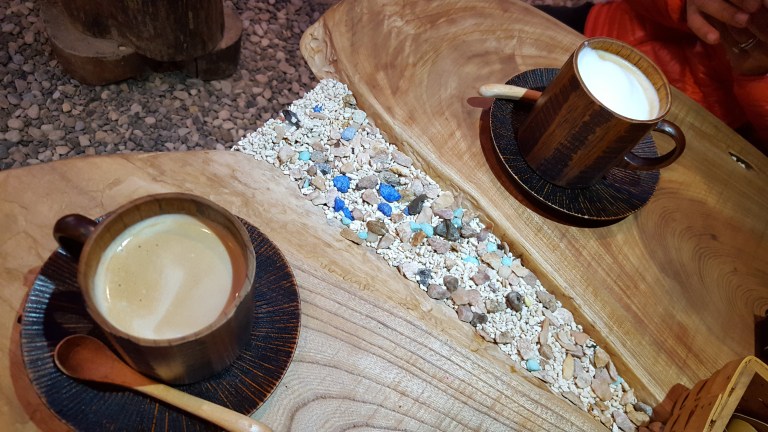
From the train station, you’ll walk by Woody’s Café Bar first. I stopped in on my way to the museum. The hot artisan coffee was a cool wet morning so it was a perfect prelude to walking around outside. It’s quite a unique spot with a Toy Story theme, hence the name. It serves coffee, lunch, dinner and is a bar at night.

20160411_115225 (1)20160411_113142

Inside the Gates: Chiang Mai Sunday Night Market – a feast, a fest, a fun time!


The Feast

This slideshow requires JavaScript.


The Fest

The Sights

This slideshow requires JavaScript.

The Sounds

The Scoop

The Chiang Mai Sunday Night Market is located in the center of the old walled city area of Chiang Mai and is open from 4pm until midnight. It’s a fest and a feast down Ratchadamnoen Road, which is closed to traffic for the Market – hence the i other name “Walking Street”. In the vicinity, there are many temples and historical sights to see along the way as well, including Wat Phan Tao, Wat Chedi Luang and the statues of the 3 kings.

Tip: If you’re not big on crowds go early and have a full run of it before they arrive.

The place really comes alive and has a great vibe later into the night…And there are some lovely restaurants, bars and coffee shops around every corner if you’d prefer people watching (tourists & Thai locals) from a distance or just need a break from the crowds.

There are musicians, handicrafts, souvenirs, massage chairs, and perhaps best of all, world renown street food enjoyed by Anthony Bourdain and myself. (My trekking tour guide from Green Trails gave Anthony his street food tour when he was filming in Chiang Mai. ) There’s so much to see, do, buy & eat, you can easily spend hours here.

Tip: If you see something you like as a gift or a souvenir get it and consider getting more than one. The crafts are Northern Thailand specific and you may not see them again. I bought a couple beautiful bowls and wish I’d grabbed more because in my 30 days in Thailand I never saw anything like them again.

If you’re thinking about going to the Chaing Mai Sunday Night Market, don’t think twice – go. As you can see and hear, it’s a memorable experience.