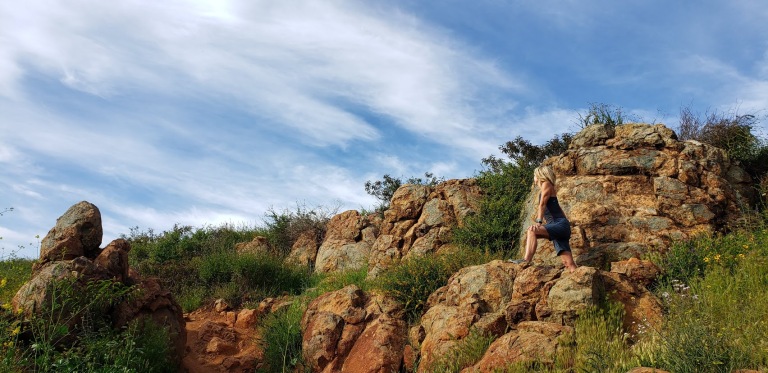
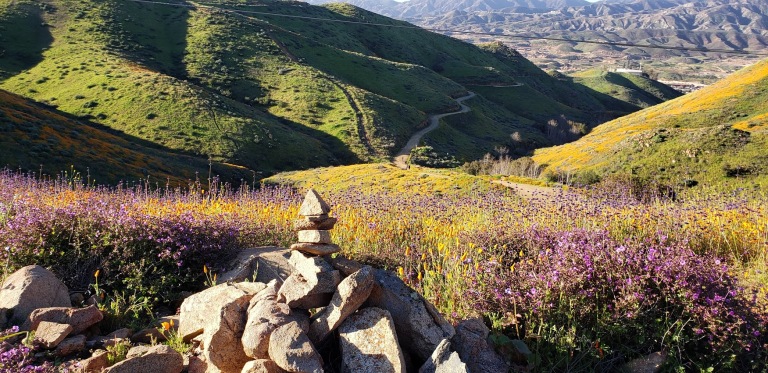
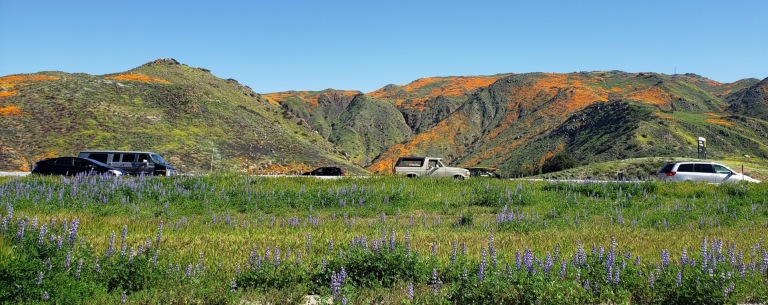
Granted, I was lucky enough to hit this hike at its most beautiful, during the spring super bloom (poppies and native wildflowers galore), but year-round, on clear days , you can enjoy lovely views of Batiquitos Lagoon and the coastline from Camp Pendleton to La Jolla.
Denk Mountain is part of Rancho La Costa, a habitat conservation area in Carlsbad made up of several non-contiguous parcels of land, including Denk Mountain and Ridgeline Trail above Box Canyon. These are some of the most rugged in the area, which make it a local mountain bikers’ favorite.
Trail notes: You have choices on this loop trail. For surer footing sake, I recommend you go up the steeper, more rugged / rocky Mule Deer Trail and come down the more moderate, less rugged Switchback Trail. The hike is completely exposed so be prepared with sunscreen, a hat and sunglasses.
Total Distance:
3.5 miles
Difficulty:
Easy to moderate – depending on your fitness level
Total Ascent
690 feet
Dogs
Leashed dogs allowed
Mt. Bikes
Bikes allowed
Facilities
None
Parking
FREE, along Corte Romero
Getting there: From the 5, take the La Costa Ave exit East and continue for 4 miles. Turn left onto Rancho Santa Fe Road and at .8 miles, turn right onto Camino Junipero, then in ~ .2 miles turn left onto Corte Romero. Park along the street. The trail head is on the right.
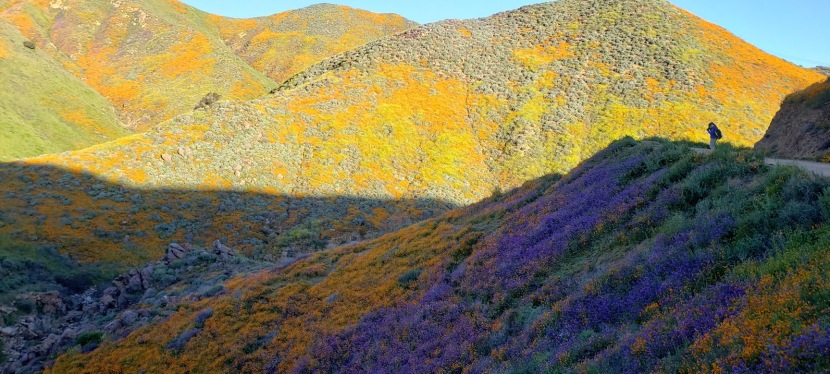
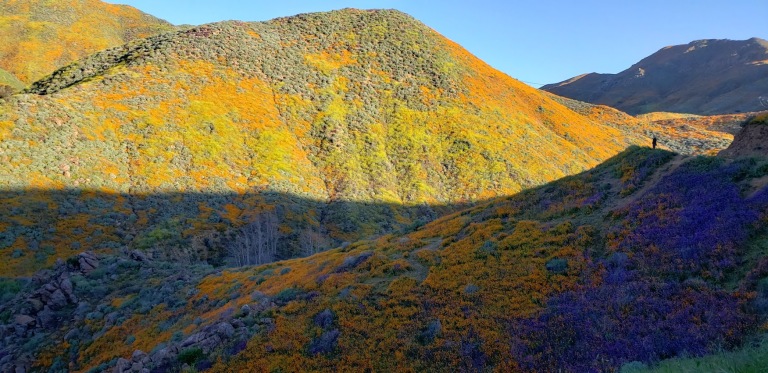
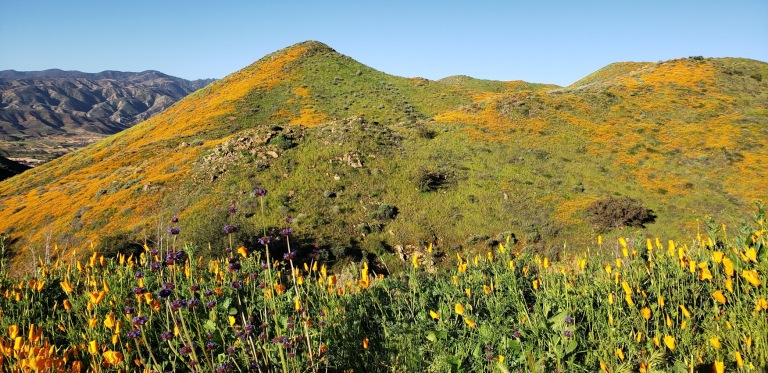
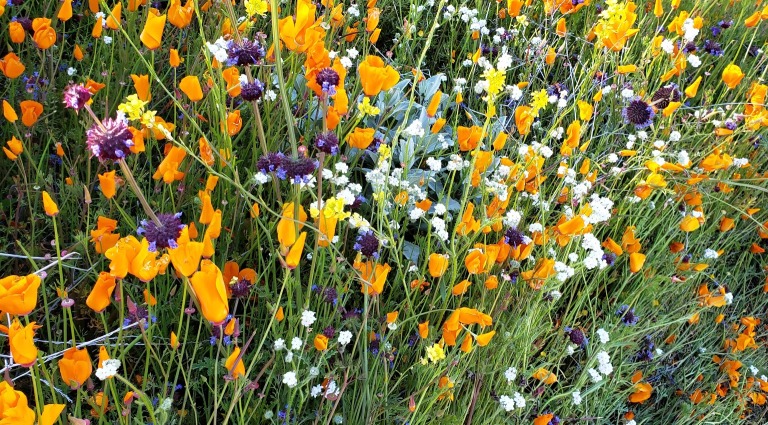
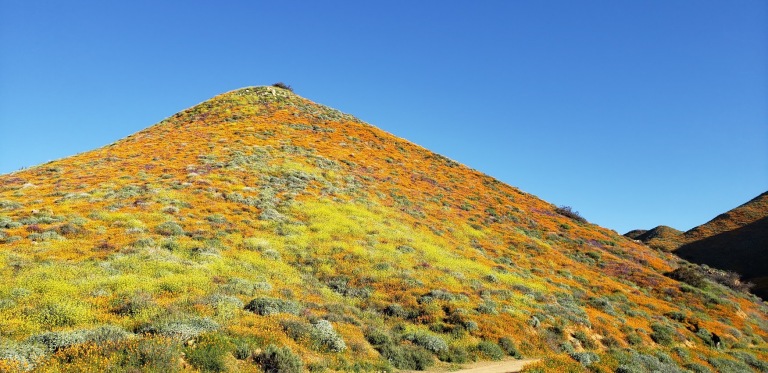
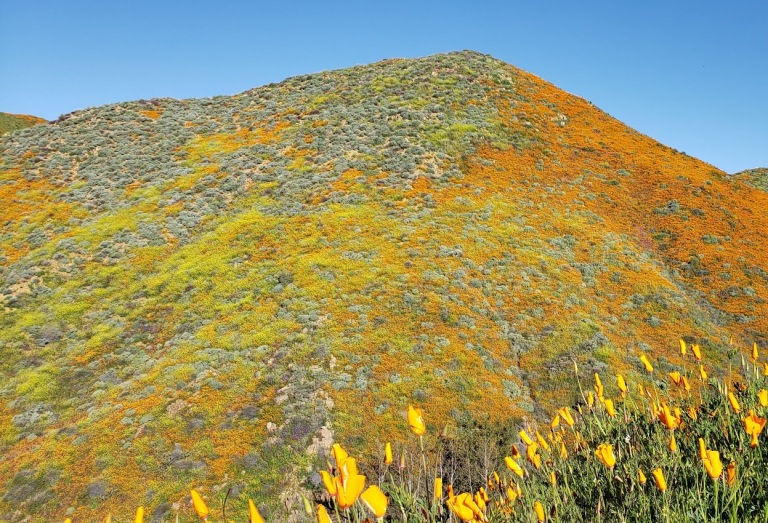
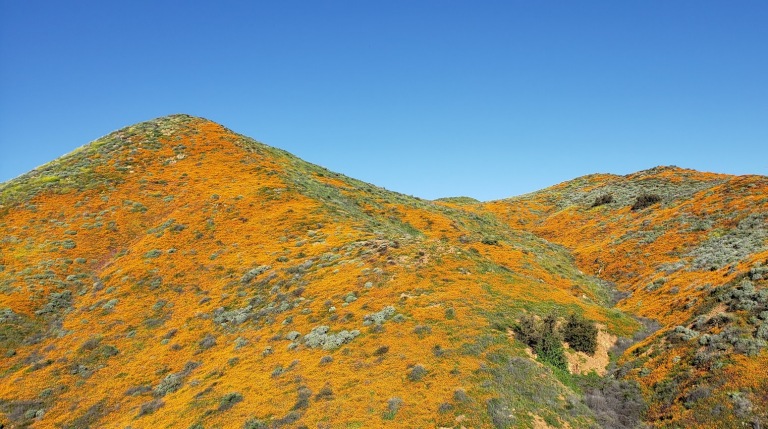
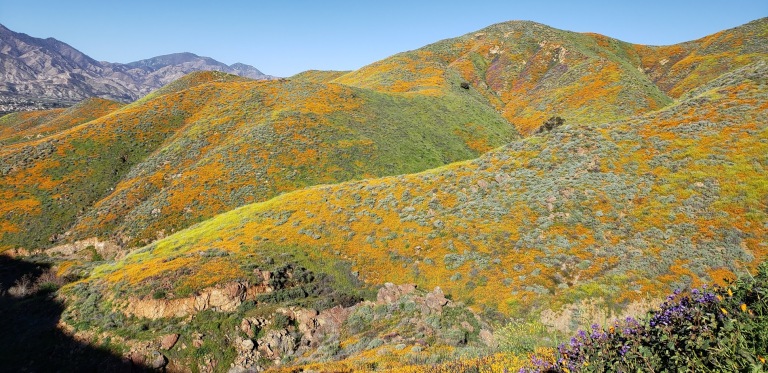
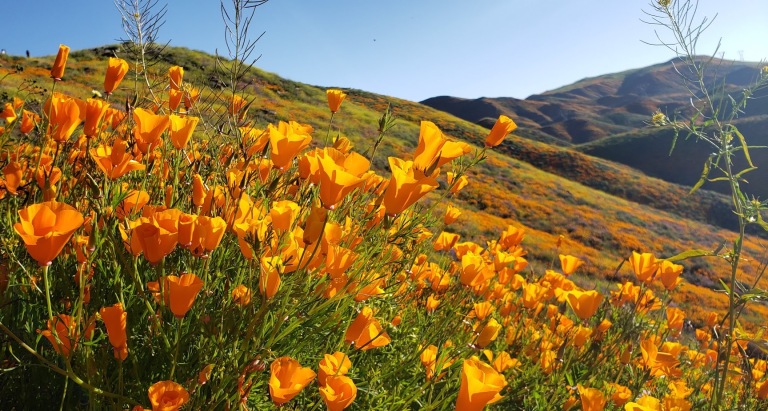
So glad I made the drive, not 1ce, but twice for this epic poppy bloom. How many times in our lifetimes does nature serve up such a spectacular treat? (Yes, I’ve experienced super blooms before, a couple years ago in Anza Borrego and way back when in Gorman, CA, but for me their magnificence never gets old.) You’ll have to pardon the abundance of pictures, I can’t help myself!
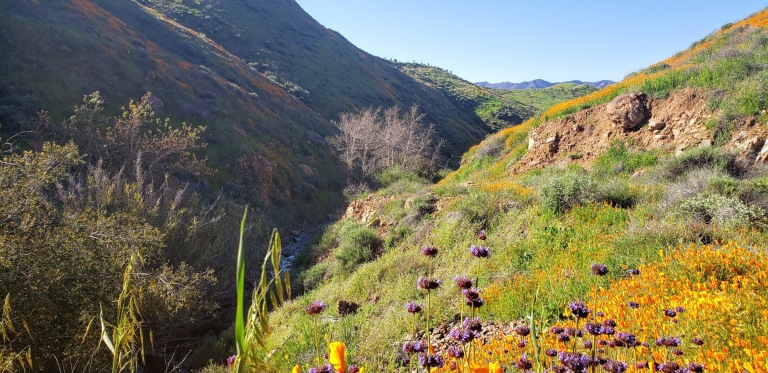
BTW, Walker Canyon is a 3.5 mile fire road out & back route in the Temescal Mountains. There’s a gradual incline, it’s perfect for trail running. The Temescal Creek flows through the bottom of the canyon. If you look closely you can see it from the trail and if you’re lucky, you might here it’s lovely musical melody too.
The downside of the super bloom? Too many humans, of course. Way, way too many humans and cars. They’re calling the Poppy Apocalypse and Flower Armageddon. But I am happy to see people getting outside and enjoying nature. (Not happy to see people trampling it though.)
Looking down on the Walker Canyon TrailMother Nature’s Splendid Bouquet
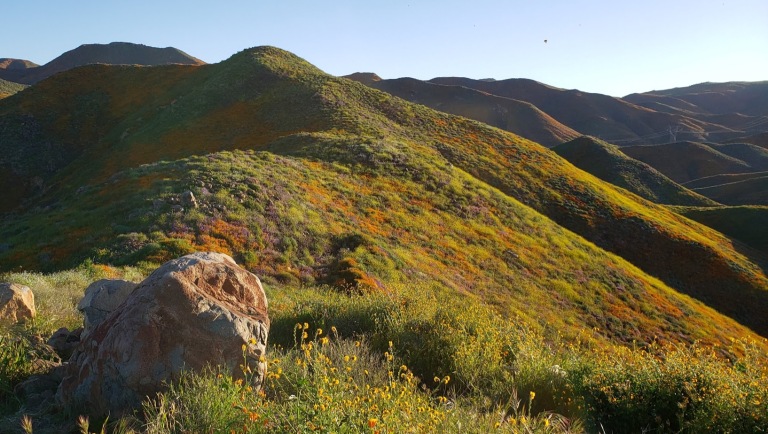
Day 2 – Spent my St. Patrick’s Day morning immersed in a flower rainbow
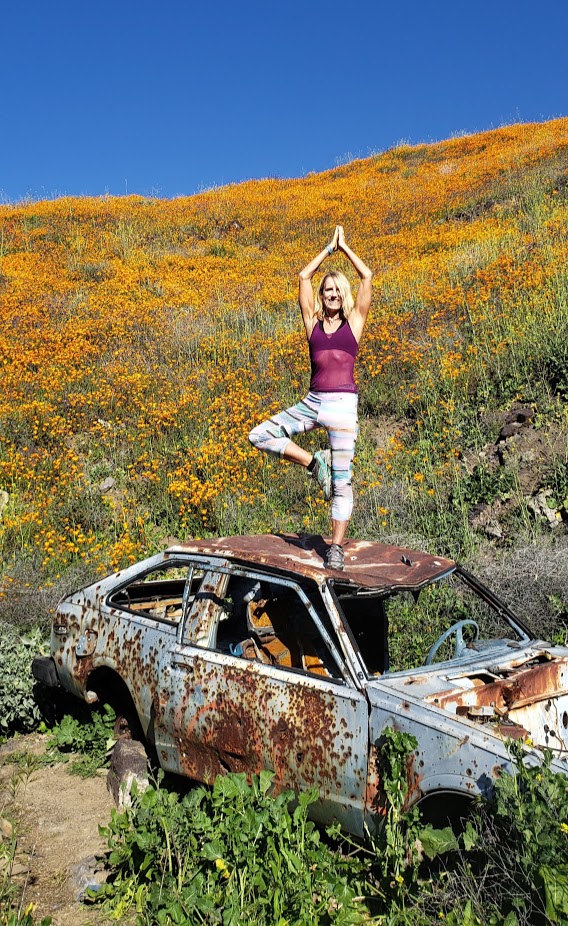
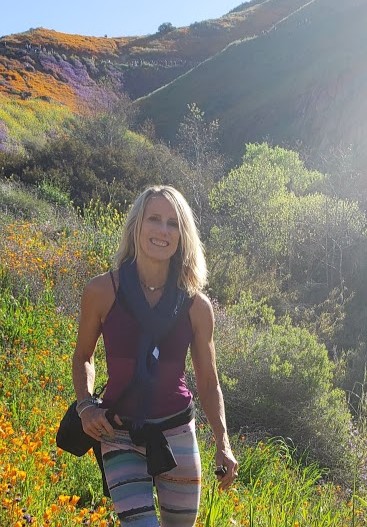
Yogi’s Bliss
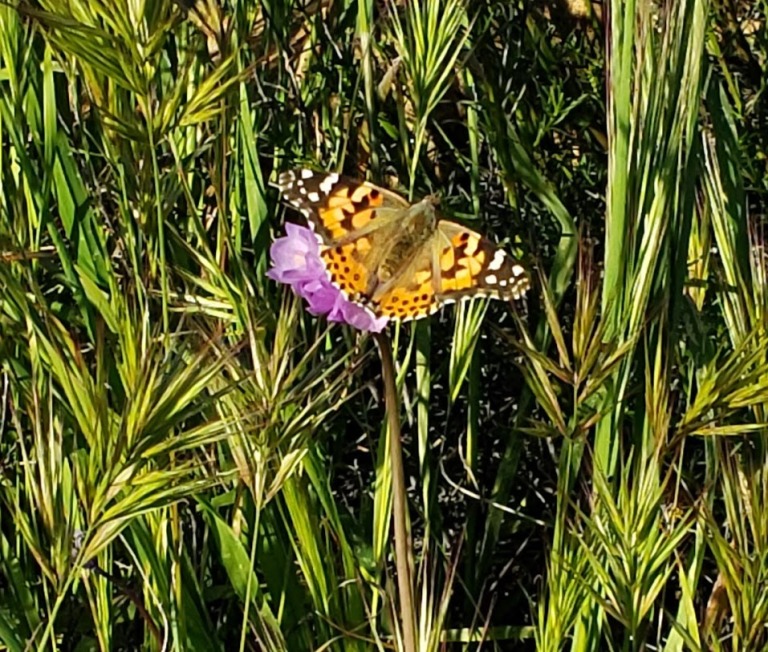
To add to the amazing spectacle, there’s a painted lady butterfly migration going on right now too!
Temescal Creek
As always, happy trails to you. Let me know which pics you like better – day 1 or 2?
Getting there: Lake Street off the 15 freeway, Lake Elsinore
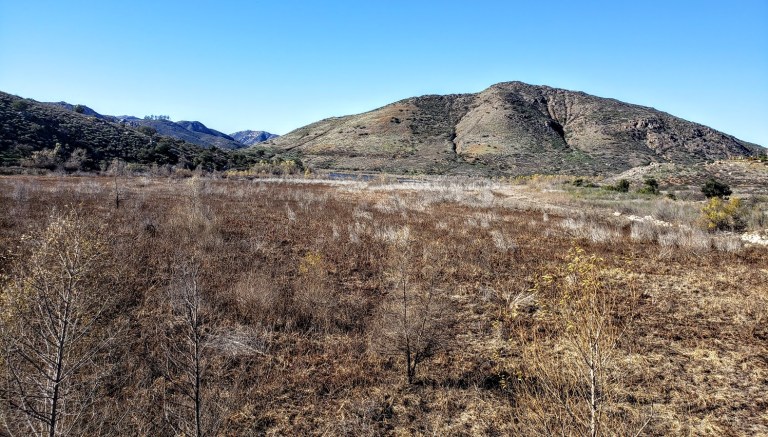
A popular spot for mountain bikers and hikers, the San Dieguito River Park in Escondido is squeezed between the I15 freeway and a couple housing developments. It’s not wilderness, but it still makes for a decent, suburban excursion and nature fix.
As I mentioned in my Cruising Lake Hodges post, the main mountain bike route on the Coast-to-Crest Trail is beginner friendly. The Bernardo Summit trail is not—it’s rated difficult due to loose rocks and steep technical sections. In other words, it’s way out of my mountain bike skill league so I left it undone on my last visit, vowing to come back and hike it. Note don’t let the words summit and mountain deter you. We’re only talking about a ~1k ft in elevation gain here. But that elevation is enough to deliver views that do not disappoint.
If you’re like me and want to bypass some concrete “hiking” and walking under the freeway, you may want to start your hike at the bicycle/pedestrian bridge (the world’s longest stressed ribbon bridge) which crosses the variably wet/dry section of Lake Hodges. After traversing the bridge, take the trail to the left heading towards the Lake. Before long, you’ll hopscotch on a couple rocks across Felicita Creek, a small perennial brook, and round the bend from there. Look for the summit trail splitting off to the right (the sign for it is facing the other direction). It’s a gradual, steady climb – mild to moderate and absolutely runnable – you just need to watch your footing on the loose rock sections. (I find it easier, more fun and less painful to run up vs. down.)
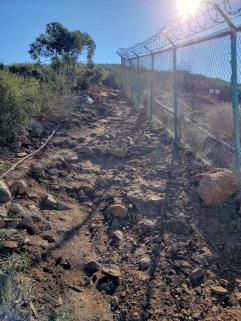
At the last and steepest section, you’ll encounter a fenced-in water tank – not very pretty, but don’t be discouraged. Your final ascent will be rewarded.
I highly recommend this hike for the best views in the park and a good workout. If you’re not up for incline, you can keep going straight along the North Shore trail to Del Dios Community Park and eventually, past the Lake Hodges Dam. Note it’s an out and back.
Hiking difficulty: Mild to moderate+ depending on your fitness level
Elevation change: ~1,000 ft
Distance: ~6.2-7.2 miles roundtrip, depending on where you start
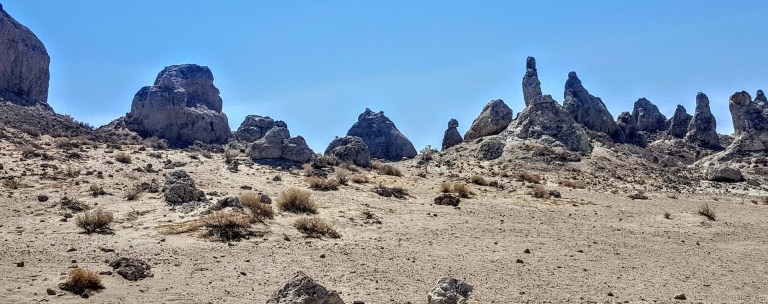
This unique geological landscape in the California Desert Conservation Area consists of more than 500 tufa spires, some as high as 140 feet, that rise from the bed of the Searles Dry Lake Basin. Composed primarily of calcium carbonate (tufa) from deep beneath the lake, the pinnacles vary in size and shape from squat and thick to tall and thin. The tufa here date back 10,000 to 100,000 years ago, forming over 3 ice ages. There are distinct in their age and elevation and are referred to as the northern group (youngest), middle group (110 spires and highest tower), and southern group (200 formations and up to 100k old). If you’ve been to Mono Lake, you’ve seen more recent formations. The expanse of desert in every direction and the stark mountain ranges on either side create a dramatic landscape.
This slideshow requires JavaScript.
Ran into a local
You can drive around the area or hike around it. Temps are triple digit in the summer so be prepared.
Getting there: ~ 20.0 miles east of Ridgecrest. Via a 5 mile BLM dirt road (RM143), usually accessible to 2-wheel drive cars, that leaves SR 178, about 7.7 miles east of the intersection of SR 178 and the Trona-Red Mountain Road. Note: The road may be closed after heavy rains.
Note: This is BLM territory so camping in this barren, impossibly hot, desert landscape is free. It’s also a great spot for offroading & ATVs.
Not sure I’d drive hours to see it, if it’s on the way as it was on my way back from my Mt. Whitney adventure, it’s worth it.
All smiles at the start. Pack Weight: His 40 lbs & Hers 20 lbs
Distance: 22 mi, rt
Difficulty: Yes, challenging – all depends on your fitness level & your knee health. Peak is 14, 505 ft elevation with a gain & loss of 6,100 ft & rocky, uneven, occasionally treacherous terrain. If you have arthritis in your knees, like me, going down is going to hurt. A lot. Even with poles.
First of all, I probably wouldn’t have done Whitney again since I’d already been there and done that (1994) and I’m not much for redos.
Circa 1994
But we were up in the area. And my swim buddy, Rosie, and a group of her friends were doing it, and Ken wanted to do it, so I figured let’s leave it to fate.
If we’re able to get a last-minute permit, we’ll do it. We had planned on doing at least 1 overnighter anyway so why not make it Whitney? Trouble is, day hike and overnight permits for Whitney are tough to get–only about 15% of people who want a permit get a permit so I didn’t have high hopes. No big deal, there are so many wonderful places to explore in the sierras, we were just winging it day by day anyway. We’d started in the Mammoth area 2 days prior and had already enjoyed a short lovely waterfall-filled, sunset hike with a tricky ending at Lundy Lake and a spectacular 11 mile day hike to Valentine Lake.
We raced down from Mammoth Lakes to Lone Pine and lined up at the Ranger and Visitor Center at 11AM sharp as instructed. Ken picked a lucky #3 out of the hat, which put us in the lead to capture a spot. Fate would have it that Mt. Whitney and I would meet again. Off we went equipped with the requisite bear canister.
Note the trail is difficult (altitude, terrain, length, elevation gain/loss). Many people train and prepare for months to do it. We are both endurance athletes and accustomed to pushing our boundaries (sometimes we are [i am] a bit too ambitious though – see our Catalina mt. bike adventure). While we were a little concerned about altitude sickness, we were relatively sure we could handle the hike.
Our trip to the mountains was last minute. We packed up in about 30 minutes and accidentally left out some key items (water purifier, hats, gloves, headlamps) at home. We stopped at the Lone Pine grocery and loaded up on munchies and water and then strolled across the street to pick up a couple headlamps at the Outfitters store.
Note, we were not prepared for high-altitude sub-freezing temps the night we camped (without a tent to keep the packs light) and the morning we hiked to the peak. I’m going to put together a camping checklist and post it here so we don’t leave home without the essentials again.
We could have cut the weight in our packs significantly if we’d brought the water purifier. Contrary to memory of 1994 there was plenty of water along the trail and at Trail Camp – lakes, streams and waterfalls.
We started on the trail at 2:30 PM with the goal of camping at Trail Camp 6 miles up, elevation 12,000 ft. I had a vision of sunrise on the peak that I wanted to fulfill – that would certainly make hiking this monster twice worth it. I had no memory of the lovely lakes, streams, and waterfalls (perhaps it was a dry year) and the beauty of the Whitney.
Note there is an earlier opportunity to camp near a waterfall at Outpost Camp just 3.8 miles up and 10,800 feet elevation.
Waterfall at Outpost Camp
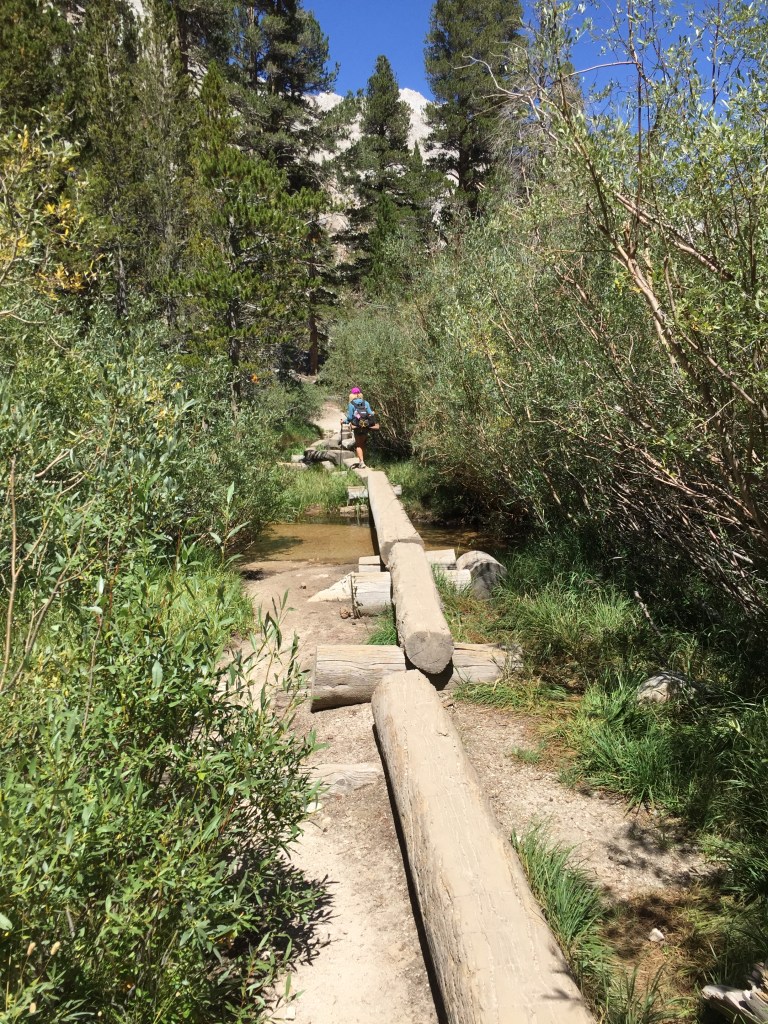
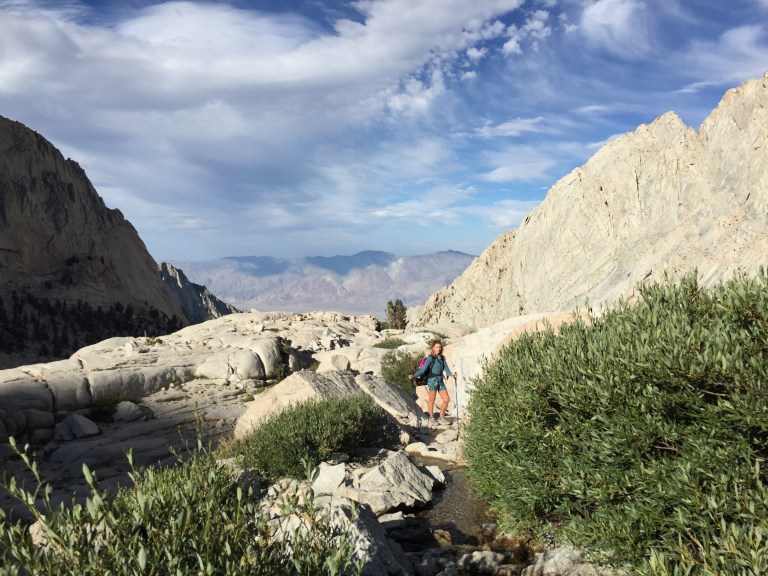
About a mile after Outpost Camp the terrain begins to get a bit more ornery (rocky)…Of course, the views become more beguiling to take your mind off the occasionally tortuous footing. Speaking of footing, I hiked both times in trail runners. Ken wore running shoes and said his feet took quite a beating. It’s really personal preference. A visual poll of hikers, coming and going, was about 50/50 hard-toe hiking shoes, running / trail running shoes.
Some hikers wore no shoes at all.
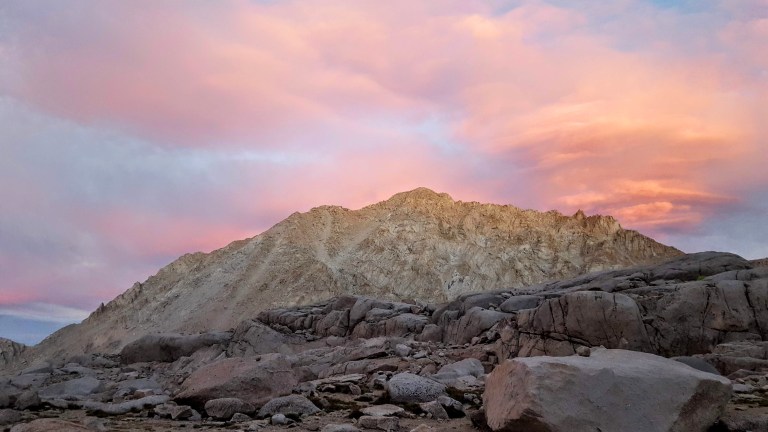
We arrived at Trail Camp at 6:30 PM just in time for sunset. At least a half dozen other hiking parties had already set up their tents. We laid out our mats and sleeping bags. I jumped in immediately, the temperature was already dropping. The video and the picture below were taken from my sleeping bag vantage point. How dreamy to experience sunset on Whitney and (fingers-crossed) sunrise too.
After chowing down on some nuts, Slim Jim’s and other munchies “in bed”, Ken put the bear canister ~150 yards away and it was lights out. My plan was for a 3:30 AM start. We didn’t sleep much—it was quite chilly (understatement). At 2:30, I saw another group rustling around with their headlamps and beginning their hike to summit. We got our start around 30 minutes later, rising at the crack of darkness to make a run for sunrise at the summit. Watching the string of headlamps bobbing in the darkness ahead and above us, snaking around the ridges through the infamous 97 switch backs was like being in an adventure film. I wish I had taken some pictures or videos, but my phone battery was low and my hands were freezing, despite my improvised sock mittens.
Unfortunately, my headlamp failed (note to self – bring extra batteries – duh). Since my eyesight is so bad, Ken let me lead with the other headlamp. The footing is quite tricky and some areas were wet so it slowed us down a bit. (The puddles had turned to ice when we reached them on the way back.)
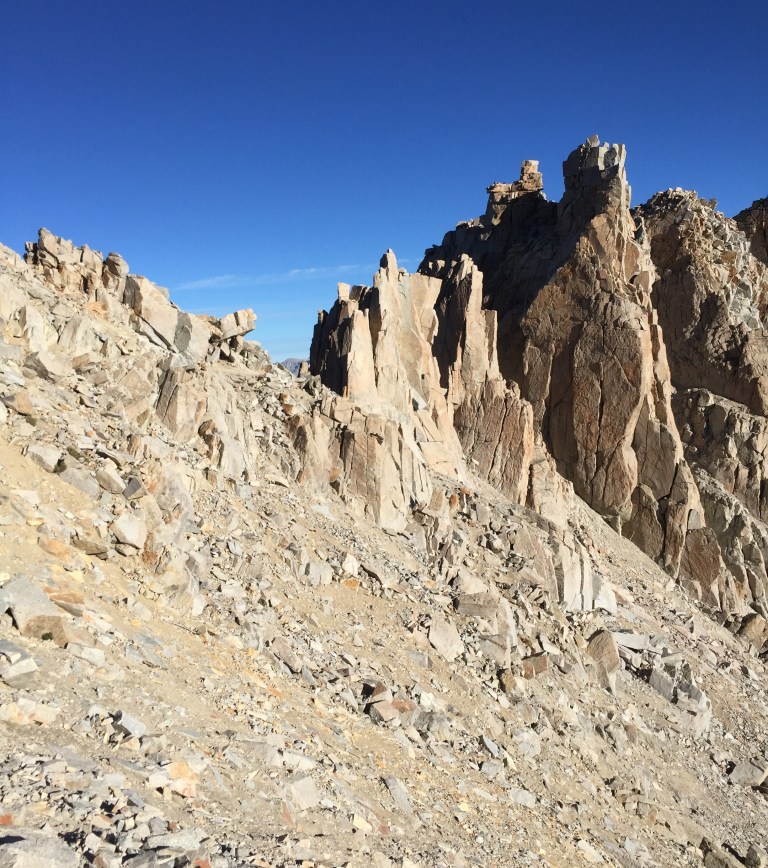
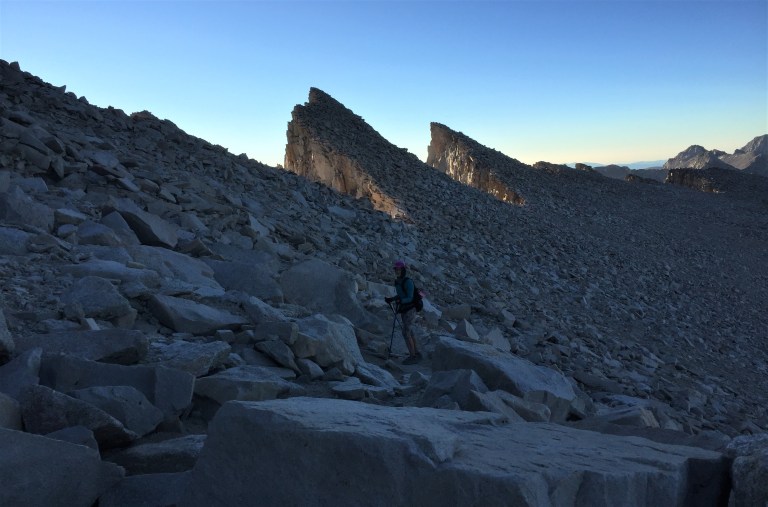
When we arrived at Trail Crest, the highest trail pass in the US (13,645 ft) it was still pitch dark and we were half -asleep and perhaps a bit altitude touched. Somehow, we misread the sign and went the wrong way – going about 1/2 mile off course. We thought it was odd that we’d be descending before the peak, but we saw some headlamps down there and none in the other direction…Despite the wrong turn, we made it to the top in time for one of the most memorable sunrises of my life.
This time, no altitude sickness at all, but you can hear me slurring my speech a tad in the video – from the cold & altitude (no mimosas, unfortunately). These past 24 years and my history of running have not been kind to my knees so the way down was much harder (hurt more) than the way up. Not sure I’ll be back again, but ya never know. Maybe I should do it every 24 years? Maybe not. Anyway, it was totally worth it.
The steep drop-offs on the upper trail were equally daunting in the dark and in the daylight.
Yes, those are socks on my frozen hands.
The view of a few of the infamous 99 switchbacks and the little lake by Trail Camp on the way down.
Ran into my swim buddy, Rosie, on the way down – her way up.
Ran into my swim buddy, Rosie, on my way down – her way up.
We made it back to Trail Camp by 9AM and out the bottom by 1:30PM – all in a days work – 23 hrs with camping. I recommend camping if you can, you get to enjoy the hike more and see more.
Many thanks to Ken for capturing and sharing his great photos on this post, for always being a great sport on my crazy escapades, and for carrying the heavier pack.
After – still smiling
My toenail causality. Guess my foot modeling days are over.
Getting there: Take Whitney Portal road from Lone Pine




 Your final ascent will be rewarded.






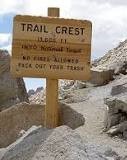 When we arrived at Trail Crest, the highest trail pass in the US (13,645 ft) it was still pitch dark and we were half -asleep and perhaps a bit altitude touched. Somehow, we misread the sign and went the wrong way – going about 1/2 mile off course. We thought it was odd that we’d be descending before the peak, but we saw some headlamps down there and none in the other direction…Despite the wrong turn, we made it to the top in time for one of the most memorable sunrises of my life.





 On the Loose Live