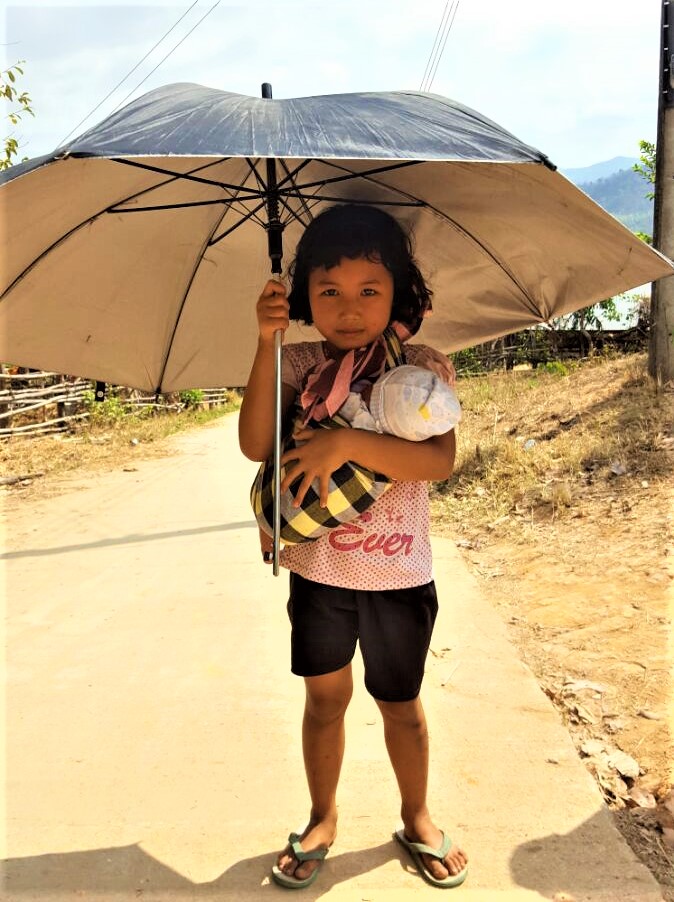
Photo Post 1: Little girl carrying her baby brother, Karen Hill Tribe

This might be my favorite photo of my entire Thailand trip. In one of my trek posts, I mentioned the big hill climb up to the Karen Hill Tribe village.  The morning we departed, this 5-year old girl was walking up the steep, long hill with the umbrella in one hand shielding her 2-week old brother whom she was carrying in her other.

little girl with baby
Big sister

She wasn’t alone. Her mom was by  her side.

Karen hill tribe girl carrying litte bro and Mom

Ayutthaya is for the bats

From Sukhothai, Ayutthaya is an 8 hour bus ride. Feels like another déjà vu travel day, except this time I made the trip in the luxury of the VIP bus. (About $12 – AC, roomy seats with legroom, a stewardess and wifi.) Well wifi was the promise – it was spotty at best so I caught up on my photo sorting and editing. I was heading South so a stop in Ayutthaya was on the way.

Also, did I mention that the open air bus terminals are clean and quiet and don’t allow smoking? Very civilized indeed.

About Ayutthaya

The ancient city of Ayutthaya, or Phra Nakhon Si Ayutthaya, is a former capital of Thailand and the ruins there are designated as an UNESCO world heritage historical park. Ayutthaya was founded in 1350 by King U-Thong when the Thais were forced southwards by northern neighbors. Over the next 417 years, 33 Kings of different dynasties ruled the kingdom until it was sacked by the Burmese in 1767.

Note: This is also a good place to rent a bike to tour around the park.

I must say, after the immaculate splendor of Sukhothai Historical Park, Ayutthaya was a big letdown. Felt like  a déjà vu too with similar ruins as Sukhothai, but Ayutthaya Historical Park is in ruin itself. Unkempt grounds with overgrown weeds, graffiti and litter. Perhaps its close proximity to Bangkok has made it suffer or maybe the community has not made preserving it a priority, who knows?

Tip: Sukhothai is my pick if you have to choose between the 2 historical parks. That being said many of the ruins at Sukhothai have signs that they have been reconstructed so it may be that Ayutthaya is more authentic.

This slideshow requires JavaScript.


Had a close encounter with some bats in the belfries of one of the temples – hence my post title.


Exploring Sukhothai Historical Park

Started the day with a 6am swim at the Imperial Chang Mai Sports Club Resort’s 55 meter pool. Perfect pool for triathletes and swimmers minus the poor air quality here. I’m told the air is only bad for 6-8  weeks of the year due to the slash and burn technique used by regional subsistence farmers. By clear cutting and burning plants, the soil is temporarily revitalized and made fertile for crops. Educational efforts are underway and there is growing momentum to switch to less eco-invasive terrace farming and rotating crops instead. Of course, old ways die hard and progress is slow.

Wanted to get a workout in before sitting on my butt for the seven hour bus trip from Chang Mai to Sukhothai. (Second class with AC is just  ~$9. Great, easy, cheap transportation. I think the short taxi ride from the bus station to the hotel in Sukhothai was more…)

Anyway, the long  trip was definitely worth it – Sukhothai Historical Park did not disappoint. And a public bus ride here is so much better than in the states. It’s clean and everyone keeps respectfully quiet, even the children. Cell phone use is kept to an absolute minimum. By the way, if you make it here, renting a bike is the way to go – only 90 cents. The ruins (some reconstructed) are amazing. The park is immaculate (fastidious workers around every corner) and there are shady trees and moats to offset the scorching heat. Go early to avoid crowds and higher temperatures.

Designated as a UNESCO World Heritage Historical Park, the ancient Kingdom of Sukhothai and former capital of Thailand existed from 1238 until 1438.

This slideshow requires JavaScript.

Mt. Bike Chiang Mai to Chang Rai Part 1

Tour company: activethailand.com
Tour guide: Pan
Difficulty: Moderate+++ (Depends on your fitness level. It’s not technical or too arduous, but some hills and scorching heat -mid to high 90s. Riding about 30 miles per day with breaks as you need them.)
Route: Chiang Mai – Chiang Dao – Ban Thaton – Chiang Rai
Experience: SPECTACULAR  trip and guide. Perhaps the best adventure of my life so far. I can’t begin to capture all the stunning scenery, savory meals and cultural sights we saw. And I can’t say enough about our wonderful guide Pan and our driver Som.

We biked through the countryside taking in the breathtaking sights along the Maekok river and valleys and through forests on singe-track trails, dirt roads and lesser traveled paved roads.

We visited hill-tribe villages, Buddhist sanctuaries, local eateries and the incredible Chiang Dao caves.  Truly an authentic, backroad, off the beaten track experience with no other tourists in sight.

Oh, I almost forgot to mention, another highlight was the longtail boat ride we took from one mountain bike area to another on the 3rd day. I’ll post videos from that next, followed by my favorite pics (people, scenery & food). I’m having so much fun, I’m getting behind on my updates.

This slideshow requires JavaScript.

 Pan

Mae Wang Trek: Karen Hill Tribe Homestay

It’s only appropriate that there be a rather long, steep climb into the village of the Karen Hill Tribe. It is here that we joined in a family’s dinner preparations, enjoyed a sumptuous feast and spent the night in a bamboo hut.

Since 1949, the Karen people have been migrating to Thailand from Myanmar due to conflicts with the Burmese government. Approximately 400,000 Karen have made Northern Thailand their home. Their villages are scattered through the mountain and lowland regions bordering Myanmar. You’ll notice some of the women in the pictures wearing their traditional colorful, embroidered smocks and skirts. This is what married women wear; single girls wear white frocks. We did not see any as the younger generation has gotten away from this and other traditions.  Now, they only wear white on Sundays, In these villages, most marry by their early twenties and traditionally it’s the mothers who chose their children’s spouses. This is still true for ~50% percent of marriages though for some it’s a choice the child makes with his / her mother. Our guide, Tui, is Karen and he and his mother will agree on his future wife.

The village where we stayed has had electricity for about a year. It’s fairly limited though with a lightbulb here and there. Some homes are open air huts, others are concrete with tile roofs. It’s a place in transition. The people are warm and friendly. Every house has a pig, several chickens, roosters, dogs, and a wealthy few have cattle too. All seem to cohabit peacefully with the exception of the flash dog fight over scraps.

Speaking of cohabitate, in a village of 130 people, 4 religions are peacefully represented: Animism (an ancient belief system before organized religion that non-human entities—such as animals, plants, and inanimate objects—possess a spiritual essence) Buddhism, Christianity, and Catholicism.

Food preparation is arduous and everyone lends a hand. Multiple dishes with multiple ingredients are made in a wok using just 1 fire source.

Famished from our full day (~2 hour bike, 3.5 hour hike), we relished this royal feast! (It included a pumpkin, garlic dish, curry potatoes and chicken, a scallion and veggie dish – oh my!)

We slept well that night!

Next up, I will share some of my favorite pics!